How to fix the forecast that's consistently 25-40% off using the right combination of activity tracking, deal intelligence, and data infrastructure

Here's a statistic that should worry every sales leader: most sales forecasts are off by 25-40%. Sometimes more. You build a pipeline that looks healthy, set targets based on that pipeline, then come up short at the end of the quarter. The usual explanation is that reps are being dishonest — padding their pipeline, sandbagging opportunities. And sure, some of that happens. But that's not the real problem.
The real problem is that your pipeline visibility is fundamentally incomplete. Reps aren't intentionally lying — they're working with partial information. They haven't logged a key customer conversation. They don't have recent engagement data. They're missing a deal stage update because the buying committee hasn't provided feedback yet. Multiply that by 20, 50, or 100 reps, and your pipeline becomes a collection of informed guesses.
The good news: pipeline accuracy is fixable. It's not a people problem, and it's not unsolvable. It's a data and tools problem. The right combination of deal intelligence, activity tracking, forecasting infrastructure, and — crucially — CRM data entry solutions can close the visibility gap and move you from gut-feel forecasting to data-driven decision making.
You might think pipeline accuracy is just a forecast hygiene issue — something that matters for board reporting and quarterly planning. But it's much bigger than that.
Inaccurate pipelines lead to fundamentally wrong business decisions. If your pipeline is overstated, you don't hire enough salespeople or don't invest in marketing soon enough. You miss growth targets and have to explain the gap. If your pipeline is understated, you over-hire, burn through cash, and create a team that can't hit quota in the current market. Either way, bad forecasts cascade into bad strategy.
But there's also a tactical impact. Inaccurate pipeline visibility means reps are managing their deals blindly. They don't know which opportunities are actually progressing. They can't prioritize intelligently. They're reacting instead of strategizing. That leads to longer sales cycles, lower win rates, and more deals slipping to the next quarter.
Pipeline accuracy is the foundation of effective sales strategy, rep productivity, and revenue predictability. Everything else flows from here.
Before diving into tools, let's diagnose why pipelines become inaccurate in the first place. There are usually three culprits:
Deal intelligence tools help you understand what's actually happening inside an opportunity beyond what the rep logged. These tools pull signals from multiple sources to give you real visibility into deal momentum.
Key capabilities:
The challenge: deal intelligence tools only work if they have good data to work with. If your CRM is missing call notes, engagement details, and activity logging, even the smartest intelligence tool will miss critical signals.
Activity tracking tools monitor whether a deal is actually progressing by measuring engagement between the rep and customer. Simple concept: high engagement usually means interest; low engagement usually means stall. But the execution requires reliable data.
Key capabilities:
The critical point: these tools depend entirely on activity being logged accurately and in real-time. If a rep talks to a customer at 3 P.M. but doesn't log the call until Friday, the tool's momentum analysis is 2-3 days behind reality. If the rep doesn't log key details from the conversation, the tool can't extract meaningful signals. Activity tracking only works if capture is efficient.
Modern forecasting tools use machine learning to predict which deals will close and when. They're more accurate than rep estimates or manager overrides — if they're fed quality data.
Key capabilities:
These tools are powerful. But they have a trash-in, garbage-out problem: if your CRM data is incomplete, your forecast will be inaccurate. If deals aren't being moved to the right stage at the right time, the model can't learn correct patterns. If activity isn't being logged, the tool can't identify stalled opportunities.
Even with the smartest deal intelligence and forecasting tools, your pipeline will be wrong if the foundational data is dirty. Data hygiene tools keep your CRM in shape.
Key capabilities:
Data hygiene feels unglamorous — it's fixing problems rather than creating new insights. But it's table stakes for pipeline accuracy. You can't build good forecasts on bad data.
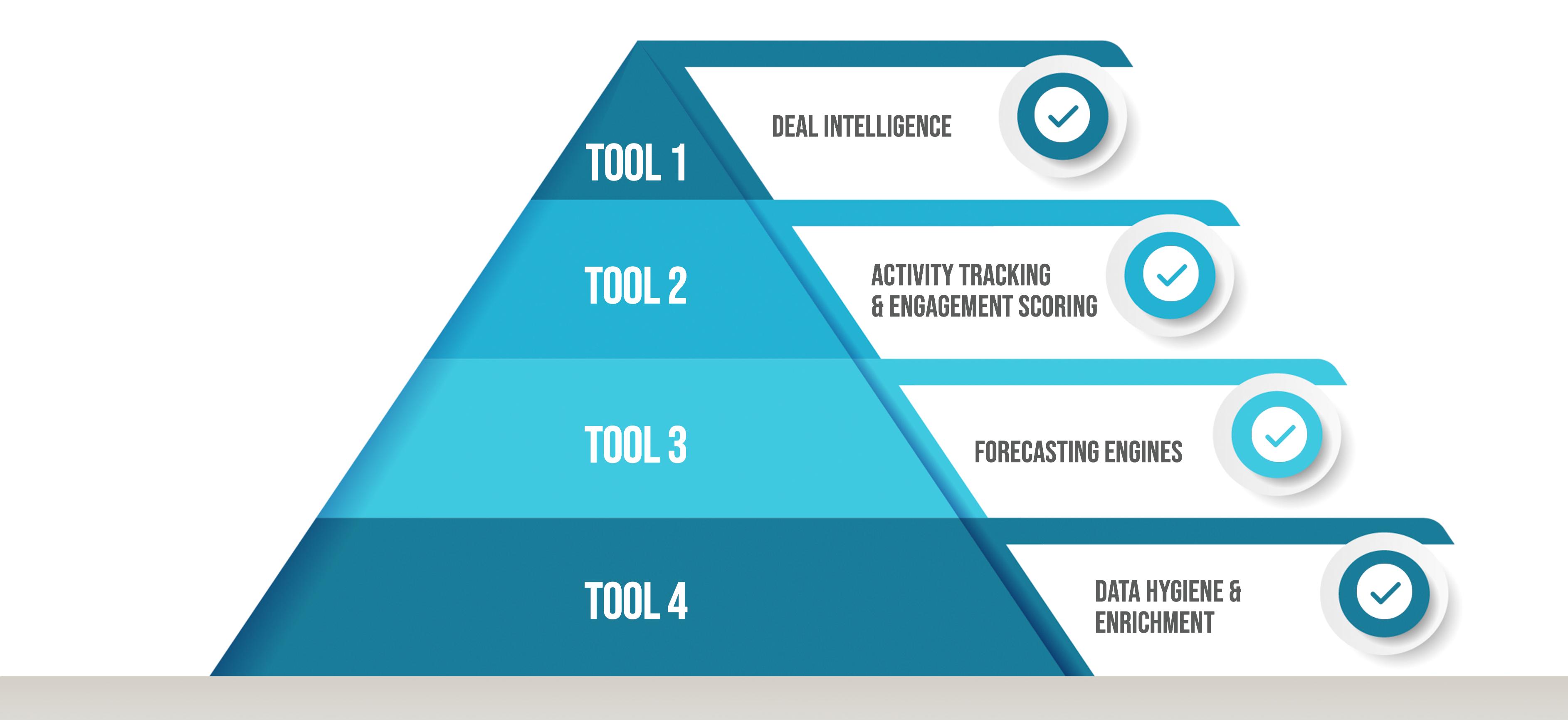
Here's the uncomfortable truth that most sales leaders don't want to admit: even if you buy the best deal intelligence, activity tracking, and forecasting tools on the market, your pipeline forecast will still be inaccurate if your data capture process is broken.
Think of it this way. A forecasting tool is like a weather model: it can predict tomorrow's weather accurately, but only if it's fed accurate input data about current conditions. If the temperature sensors are broken, the wind speed measurements are hours old, and the humidity readings are being estimated instead of measured, the model's prediction will be wrong.
The same is true with your CRM. If deals aren't being updated in real-time, if activity logging is happening days after conversations, if notes are abbreviated or missing context, if the buying committee status is unknown, then every downstream tool — your deal intelligence, your forecasting engine, your activity tracker — is working with stale, incomplete, unreliable information.
The typical response is to add more oversight: more forecast calls with reps, more deal reviews, more manager verification. But this is just detecting the problem, not solving it. The solution is fixing how information flows into the CRM in the first place.
Most sales teams have optimized their 'system of record' — their CRM is configured, their fields are defined, their workflows are set up. But they've neglected their 'system of capture' — the process by which information actually gets into the system.The typical process looks like this: rep talks to customer, goes back to their desk, opens their CRM, types notes, fills in fields, moves the deal to the next stage. This process has built-in delays (hours or days between conversation and logging), incompleteness (reps skip fields or abbreviate notes), and inconsistency (different reps follow different rigor standards).
Modern capture infrastructure solves this by making data entry frictionless. A voice to CRM solution, for example, allows reps to speak their notes immediately after a meeting. Intelligent systems transcribe and structure that audio into clean, detailed, properly-categorized information in the CRM — without requiring manual typing. The result:
This is why capture infrastructure deserves to be a primary focus of your pipeline accuracy strategy. Every tool we've discussed — deal intelligence, activity tracking, forecasting — depends on it. Without it, you're building an accurate forecast on an inaccurate foundation. Learn more about how solutions in the capture layer unlock better pipeline visibility.
Consider a real scenario: A VP of Sales implements a new forecasting tool that's supposed to improve forecast accuracy by 30%. The tool is sophisticated, uses machine learning, analyzes hundreds of deal signals. The board is excited. Three months later, the forecast is still off by the same amount, and the VP is wondering why the investment didn't work.
The issue: the forecasting model was trained on the company's historical data. But that historical data was full of the same problems that plague the current pipeline — incomplete stage transitions, missing activity logging, stale deal information. The model learned to predict based on bad data, so it continues to make bad predictions.
Meanwhile, her team is also implementing activity tracking to identify which deals are truly progressing. But activity tracking only works if recent activities are being logged in the CRM. Because her team logs activities sporadically and inconsistently, the engagement scores are not meaningful. A deal might look cold in the system because the rep hasn't logged recent customer contact, even though the deal is actually hot.
The answer isn't better tools. It's better data. And better data comes from fixing the capture process.
If you're ready to move from gut-feel forecasting to data-driven accuracy, here's a practical framework:
The sequence matters. Skip Phase 1 and invest in Phase 5, and you'll be disappointed. Get Phase 1-3 right, and your forecast will improve even before you implement fancy forecasting AI.
Here's where to start:
For more perspective on how to transform your sales operations, read about 7 CRM adoption concerns and the cost of manual CRM data entry.
Pipeline accuracy isn't a nice-to-have for sales leaders — it's foundational. Inaccurate forecasts cascade into bad hiring, bad strategic decisions, and rep confusion about which deals to prioritize.
The good news: pipeline accuracy is fixable. But it's not a tools problem alone. It's a data problem, and data comes from process. The right combination of capture infrastructure, activity tracking, deal intelligence, and forecasting tools can move you from 25-40% forecast misses to much tighter accuracy.
The key is starting with capture. Every other tool you implement depends on it. If you fix capture and keep it fixed, the rest becomes much simpler.


