You are the entire sales organization.
You prospect. You qualify. You demo. You close. You onboard. You service accounts so they renew. You might also handle customer support, manage partnerships, and chase down prospects who’ve gone dark.
There’s no sales ops person doing admin. There’s no sales manager handling forecasting. There’s no marketing team generating qualified leads. It’s you.
The tools a sales team uses—Salesforce, Outreach, Gong, Clari—are built for teams. They assume you have other people handling different parts of the process. A solo rep using enterprise software is like buying a tour bus to drive alone.
Which is why the smart solo sales operation is built differently.
You need affordable tools. Every dollar spent on software is a dollar not spent on sales activities or reinvested in growing the business. You need tools that work for one person, not ten. And most importantly, you need tools that don’t steal your time with administrative overhead. The CRM data entry challenge hits solo reps hardest — there’s no team to absorb the cost.
The good news: You can build a powerful solo sales operation on $0 to $500/year in software. HubSpot CRM Free, Calendly, and Zoom are the backbone. They’re designed to work together, they’re easy to adopt, and they actually work.
The bad news: They still have a critical limitation. And that limitation is slowly killing your productivity and your conversion rates.
This article walks through the affordable three-tool stack, shows exactly where it breaks down for solopreneurs, and reveals the single tool that transforms a scrappy operation into a scaled one—without you hiring anyone.
HubSpot’s free CRM tier is genuinely remarkable. For a solo rep, it’s probably 90% of what you need, and the price is hard to argue with.
What It Is
HubSpot CRM is a cloud-based contact and deal management system. It’s where your prospects and customers live, where your deals progress through pipeline stages, and where you manage follow-up activities.
Core Functionality
For solo reps, HubSpot Free gives you contact management—storing prospect information, interaction history, and notes in one place. It includes a deal pipeline where you can track opportunities through stages and see your revenue forecast. You can create sequences of emails that automatically follow up with prospects on your schedule. The built-in email tracker shows you when prospects open your emails and click links, so you know who’s actually engaged.
HubSpot’s mobile app means you’re not tethered to your desk. You can log activity and update deals from your car or a coffee shop. For a solo rep constantly moving between customer meetings, that’s valuable.
The free tier is surprisingly functional. You can run a real sales operation on it. At the lower end, Starter plan ($20/month) adds a few conveniences like automation and advanced reporting, but Free is legitimately sufficient.
The Limitation
HubSpot Free/Starter is a remarkable value. But it still requires you to enter every meeting note, task, and deal update manually.
For a solo rep doing 5+ customer meetings per day, this is a problem. You finish a call with a prospect. You should immediately capture: What was discussed? What did they say about the budget? What’s the timeline? What’s the next step? Who are the decision-makers? What’s the competitive situation?
But instead, you’ve got another call in 15 minutes. Or you’re driving to meet someone else. Or it’s 5 p.m. and you’re exhausted. So you don’t capture it. Maybe you jot a quick note: “Good call, moving forward.”
Then Wednesday rolls around. You try to update your CRM. But you can’t remember the details from three meetings. You halfheartedly type some notes. You mark the deal as “moving forward” without specifics. And you promise yourself you’ll catch up on it later.
You never do.
HubSpot Free is perfect infrastructure. The problem is that the infrastructure only works if you feed it complete information. And for a solo rep, feeding it complete information requires discipline—and time you don’t have.
Understanding why CRM adoption fails is crucial here. Solo reps see data entry as admin work, not strategic value. They’re not wrong. From their perspective, time in HubSpot is time not selling.
Scheduling is a hidden tax on sales operations. Every time a prospect says “Let’s find a time to talk,” a negotiation begins. You send her three times that work for you. She picks one but then asks if Wednesday works instead. You check your calendar, respond. She’s unavailable Wednesday but can do Thursday. This email tennis continues for 2-3 days before you finally land on a time.
Calendly eliminates this.
What It Is
Calendly is a scheduling app. You connect your calendar, set your availability rules, and share a booking link. Prospects click the link, see your open times, and book a meeting. The meeting appears on your calendar automatically.
Core Functionality
With Calendly, your availability is always current. You set rules like “I’m available 9 a.m. to 5 p.m. on business days, no back-to-back calls, 30-minute gaps for break time.” Prospects see real open slots and book without asking you. Calendly sends them a confirmation with meeting details and a Zoom link (if you integrate them). It sends you a reminder 15 minutes before, and it sends the prospect an automated reminder so no-shows drop dramatically.
The Professional plan ($12/month) adds round-robin scheduling if you’re part of a team and custom branding so it feels like your tool, not Calendly’s.
The Limitation
Calendly is brilliant at getting meetings on the calendar. It completely eliminates scheduling friction. But it doesn’t help with anything that happens during or after the meeting.
Call ends. Prospect was interested. There was a budget discussion. She mentioned a concern about integration. You’ve got their commitment to a next meeting. Now what?
You need to update Salesforce. You need to create a follow-up task. You need to log activity and next steps. You need to document what was actually discussed. That’s still manual. It still takes time. And for a solo rep, it’s still the admin work that competes with actually selling.
Zoom is the standard for remote and hybrid meetings. It’s ubiquitous, it works everywhere, and it’s free for most solo rep use cases.
What It Is
Zoom is a video conferencing platform. You host a meeting, share your screen for demos, record the conversation if you want, and keep the meeting going until you’re done.
Core Functionality
For solo reps, Zoom’s free tier covers unlimited 1-on-1 calls. You can host up to 40-minute group calls (sufficient for team demos but most of your calls are 1-on-1 anyway). Screen sharing lets you walk prospects through your product during a demo. You can record calls for your own reference (though you should always ask permission first). Zoom handles all the technical lifting—no one is confused about how to join, how to access your screen, or whether the audio is working.
The Professional plan ($149/year) removes the 40-minute limit on group calls and adds some scheduling convenience, but for most solo reps, Free is plenty.
The Limitation
Zoom is the meeting room. It’s excellent at hosting the conversation. But once the call ends, there’s no automatic record of what was discussed, what was agreed, or what the next step is.
The intelligence from that conversation exists only in your memory. And memory fades fast. By your third call of the day, the details of your first call have already started blurring. By tomorrow, you’re not sure if that prospect said they’d have a budget in Q1 or Q2.
The three-tool stack—HubSpot, Calendly, Zoom—costs almost nothing. You can run a complete sales operation on $0 to $181/year. That’s the dream for a solo rep starting out or bootstrapping a business.
But the cost of operating this stack is paid in time, not dollars.
Here’s what a typical week looks like with the three-tool stack:
Monday: You have 5 customer calls. Calendly books them seamlessly. Zoom hosts each one smoothly. You talk to prospects, learn about their problems, and discuss solutions.
Monday evening: You sit down to update your CRM. You try to remember all five conversations. You type notes in HubSpot. You mark deals with stages. You set follow-up tasks. This takes 45 minutes.
Tuesday: More calls. More end-of-day admin.
Wednesday: You’re behind on admin. Two conversations from Monday are still not fully logged. You’re trying to remember details.
Thursday: You realize you promised a proposal to one prospect but can’t remember the specifics of what you discussed. You send a vague email asking for confirmation.
Friday: End of week catch-up. You have 90 minutes of admin work piled up. You could be prospecting. You could be closing deals. Instead, you’re typing notes into HubSpot.
This happens every week. And the compounding effect is devastating.
The three-tool stack is cheap. The time it steals is expensive.
Let’s do the math.
You have 5 customer meetings per week. Each meeting requires note-taking after the fact. You need to document: what was discussed, what was promised, what the decision-maker said about budget and timeline, what the competitive situation is, what objections remain, when you should follow up.
Done quickly, that’s 15 minutes per meeting. Done thoroughly, it’s 20+ minutes.
5 meetings × 20 minutes = 100 minutes per week spent on admin.
100 minutes × 48 working weeks per year = 80 hours per year.
80 hours × your fully loaded rate (let’s say $100/hour for a productive solo rep) = $8,000 in opportunity cost.
Your HubSpot + Calendly + Zoom stack costs maybe $150 to $180/year. But it’s extracting $8,000 in annual time cost.
Here’s the scenario that plays out regularly:
You have four customer meetings on a Thursday. In each conversation, there’s important movement. A budget owner gives preliminary approval. A decision-maker expresses a concern. A competitor is mentioned. The timeline gets clarified.
You’re still thinking about these conversations when you leave. But you’ve got another internal meeting, some emails to answer, an invoice to send out.
Thursday evening: You finally sit down to update HubSpot. You’ve got about 30 minutes before you want to be done for the day. You try to recreate four conversations from memory. You miss nuances. You forget the exact budget figure. You’re not sure if that concern about integrations was a deal-breaker or a standard question. You type something like “Good progress, moving forward.”
Friday morning: You’re supposed to send a proposal. But you don’t have complete details from Thursday’s conversations. You send a generic proposal and ask the prospect to confirm a few details.
The prospect responds Monday. Some details were wrong. She has to correct you. The deal slips by a week because of the back-and-forth instead of moving forward smoothly.
This is the admin tax. It compounds: incomplete capture → missed context → delayed follow-up → slipped deals → lower conversion rates.
For a solo rep, conversion rate is literally your revenue. If your conversion rate is 20%, and your average deal size is $10K, you need to talk to 50 prospects to close $100K. If admin overhead and incomplete deal notes drop your conversion to 15%, you now need to talk to 67 prospects to close the same $100K. You’ve added 34% to your prospecting workload.
The paradox of solo sales is that you’re your own biggest limitation. You don’t need more prospects. You need to stop wasting your time on admin.
You can’t hire a $35K/year assistant. But there’s another option.
What if every customer conversation automatically updated your CRM with complete, accurate information—without you typing anything?
That’s what voice-to-CRM does. It’s not a complicated concept, but the impact is profound.
How It Works in Practice
Scenario 1: Without voice-to-CRM.
You have four meetings Thursday. After the fourth meeting, you’re mentally drained and there’s evening traffic. You get home, try to update HubSpot, and end up with sparse notes because you can’t remember everything.
Scenario 2: With voice-to-CRM.
Same four meetings Thursday. After meeting #1, while walking to your car, you spend 90 seconds speaking into your phone: “Great conversation with the prospect. They’re evaluating us and one other vendor. Budget is $120K but they might find an extra $30K if we can implement faster. Timeline is Q2. Decision-maker is the CFO. She wants a demo next Tuesday. Main concern is integration with their existing system. Next step: send proposal with integration details by Friday EOD.”
That 90-second voice note is automatically transcribed and ingested into your HubSpot deal. The opportunity updates with complete information: budget, timeline, decision-maker, next step, competitive situation, main objection.
You do this after meetings #2, #3, and #4. Total voice capture time: 6 minutes. Total admin time saved: 50 minutes.
Friday morning, you send proposals with complete context. They’re specific, not generic. Prospects feel heard. Conversion probability goes up.
Because your HubSpot is complete, your follow-ups are sharp. You’re not asking for clarifications. You’re closing.
The compounding effect: Over a year, 5 meetings/week × 50 minutes saved = 4,000 minutes = 67 hours saved. At $100/hour, that’s $6,700 in reclaimed time. You could use those 67 hours to prospect more aggressively, close deals faster, or—honestly—have a life outside of work.
For the investment of $1,800/year in voice-to-CRM, you’re getting $6,700+ in reclaimed time.
Let’s break this down clearly for solo reps.
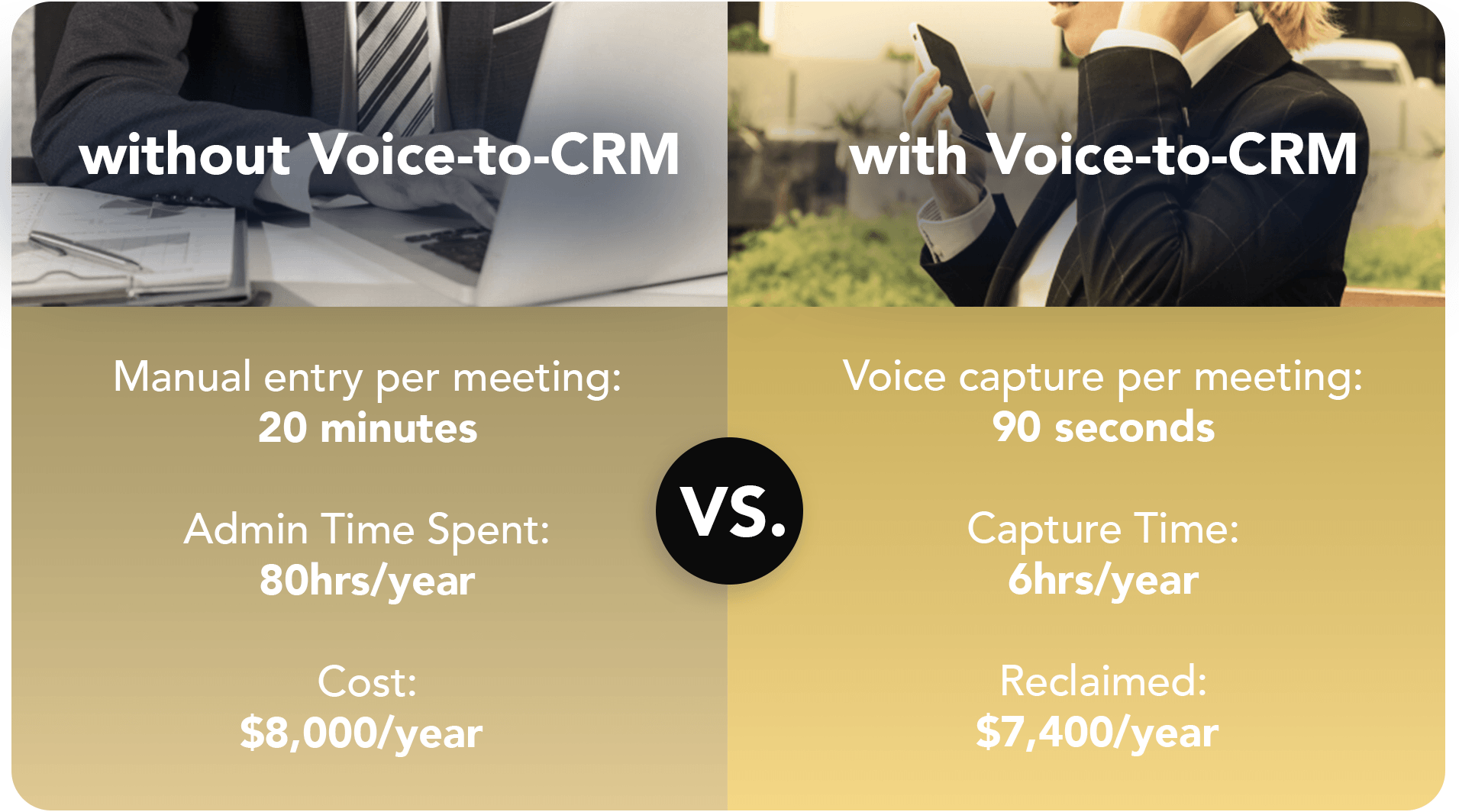
Without voice-to-CRM: - Manual entry per meeting: 20 minutes - Meetings per week: 5 - Annual admin hours: 80 - At $100/hour fully loaded: $8,000/year in time cost - Plus: Incomplete notes lead to delayed follow-ups and lower conversion
With voice-to-CRM: - Voice capture per meeting: 90 seconds Explore Hey DAN’s full capabilities to see exactly how it integrates with a solo sales stack. - Meetings per week: 5 - Annual capture time: 6 hours - Time saved annually: 74 hours - At $100/hour: $7,400 in reclaimed time - Plus: Complete notes lead to sharp follow-ups and higher conversion
Voice-to-CRM investment: $1,800/year Net direct benefit: $7,400 - $1,800 = $5,600
That’s a 311% ROI on time alone.
But here’s the bigger number: If better follow-ups from complete deal notes improve your conversion rate from 18% to 22%, and your average deal is $10K, that’s an extra $20K in annual revenue per 100 conversations. That’s the real ROI.
For a solo rep, voice-to-CRM isn’t an expense. It’s a leverage tool. It’s how you scale your capacity without hiring. Companies with successful CRM strategies started by solving the data entry problem — and solo reps who do the same build better habits from day one.
Here’s what solo reps don’t talk about: the emotional cost of the admin tax.
You finish a productive day of selling. You had five good conversations. You made progress on deals. And then you’ve got 45-90 minutes of note-taking ahead of you. You can either do it now, exhausted, knowing you’ll do a mediocre job and miss details. Or you defer it, letting it pile up. Either way, your evening is consumed.
With voice-to-CRM, that’s gone. Five 90-second voice captures, and you’re done. Your evenings are actually free. Weekends aren’t spent catching up on admin. You don’t dread Friday afternoons because there’s no mountain of unprocessed information.
For solo reps, that freedom is enormous.
HubSpot Free + Calendly + Zoom cost $0 to $181/year.
Add voice-to-CRM for $1,800/year.
Total: $1,800 to $1,981/year.
That $1,800 is the most leveraged investment a solo rep can make. It’s a virtual assistant that works 24/7, never complains, never quits, and scales your capacity without headcount.
Why is this important? Because solo reps typically operate at capacity. You can only have so many conversations per day. You can only manage so many prospects at once. You’re limited by hours in the day and your own energy.
Voice-to-CRM removes the admin tax. The hours you were spending on note-taking and deal management are reclaimed. You can have more conversations. You can close more deals. You can actually scale.
Jamie is a freelance B2B SaaS consultant. She sells implementation services to companies with new SaaS platforms. Her average deal is $15K. She typically closes 3-4 deals per month.
Monday 9am: Jamie has her first call of the day with a prospect who’s considering her services. In 45 minutes, she learns about their implementation needs, timeline, budget constraint ($50K to $75K), and main concern (integration with existing systems).
9:50 a.m.: Jamie walks to her car and spends 90 seconds speaking her summary: “Prospect is a mid-market company evaluating implementation partners. The budget is $50K to $75K with possibility of expansion. The timeline is Q2. The main concern is integration with their legacy system. Decision-maker is the CTO but budget comes from the CFO. Next step: send proposal by Wednesday. Main objection to address: we need to prove integration track record.”
The voice note is transcribed and ingested into HubSpot. Her deal is updated.
10 a.m.: Second call with an existing client following up on another project.
10:50 a.m.: Another 90-second voice note.
1 p.m.: Lunch.
2 p.m.: Third call with a new prospect exploring her services.
2:50 p.m.: Third voice note.
3:30 p.m.: Call with a prospect from last week. Jamie already has complete context in HubSpot because she captured it that day. She doesn’t have to ask clarifying questions. The conversation moves directly to addressing objections and moving the deal forward.
4:30 p.m.: Final voice note.
5 p.m.: Jamie is done for the day. Her HubSpot is completely current. She knows exactly what the next step is for each deal, what the budget is, what the timeline is, and what each prospect’s main concern is.
5:05 p.m.: Jamie sends proposals. They’re specific and detailed because she has complete context. They address the exact concerns each prospect mentioned.
6 p.m.: Jamie’s personal time begins. She’s not thinking about admin work. She’s not daunted by a catch-up session.
Compare this to the typical solo rep week without voice-to-CRM: Each evening contains 1-2 hours of admin. Friday is brutal—a backlog of meetings to process. Proposals are generic because deal notes are incomplete. Prospects sense the lack of personalization. Deals slip.
Jamie’s reality is different. She’s not working harder than solo reps without voice-to-CRM. She’s working smarter. Her energy is focused on selling and closing, not processing.
And her conversion rates are higher because prospects are getting relevant, contextual responses instead of generic follow-ups.
Solo sales doesn’t mean working harder than everyone else. It means being smarter about where you spend your time and energy.
The three-tool stack—HubSpot, Calendly, and Zoom—is genuinely affordable and genuinely powerful. You can run a real, productive sales operation on $0 to $500/year. That’s the advantage of operating as a solo rep in 2026: the tools that used to be enterprise-only are now accessible to everyone.
But the three-tool stack has a silent killer: the admin tax. Every meeting requires manual processing. Your CRM either stays incomplete and unreliable, or you spend your evenings keeping it current. You can’t win that trade-off.
Voice-to-CRM solves the problem. It’s the missing piece that transforms the affordable stack into a complete, scaled operation. It’s not another tool to learn. It’s a 90-second workflow that captures the intelligence from customer conversations and automatically feeds it to your CRM.
The investment is $1,800/year. The return is 67 hours of reclaimed time annually, better deal context for every conversation, higher conversion rates, and—most importantly—evenings and weekends actually free.
For a solo rep, that’s not an expense. That’s leverage. That’s how you scale without hiring. That’s how you turn a scrappy operation into something sustainable.
Your time is your inventory. Every minute in admin is a minute not selling, not closing, not growing. Voice-to-CRM gives those minutes back to you.


