
Sales managers occupy an impossible position. You’re responsible for pipeline visibility across 10, 20, or 50 deals simultaneously. You need to know which opportunities are genuinely progressing toward close and which are stuck. You need to forecast accurately for board calls. You need to coach reps on deals where you weren’t in the room. You need to do all of this while managing emails, 1-on-1s, and your own quota pressure.
Technology should help. And the market has delivered: Salesforce for pipeline management, Clari for AI-powered forecasting, Gong for conversation intelligence. These are the backbone of modern sales management. Many organizations invest $100K-180K annually in this stack.
But here’s the problem: According to CSO Insights, only 45% of forecasted deals actually close. That 45-point gap isn’t because the tools are broken. It’s because they’re built on broken data.
Most sales teams have a CRM data entry challenges crisis they don’t want to admit. Industry averages show 40-50% field completeness on opportunities. Deal notes are sparse. Next steps are undocumented. Decision-maker sentiment is guessed at. When reps update Salesforce sporadically—or worse, only during forecast calls—your analytics tools are making predictions from incomplete intelligence.
You’ve invested in premium forecasting technology. The foundation it stands on is quicksand.
This article walks through the three-tool stack sales managers rely on, exposes where it breaks down, and shows you the missing piece that transforms these expensive tools from guesswork generators into genuine predictive engines.
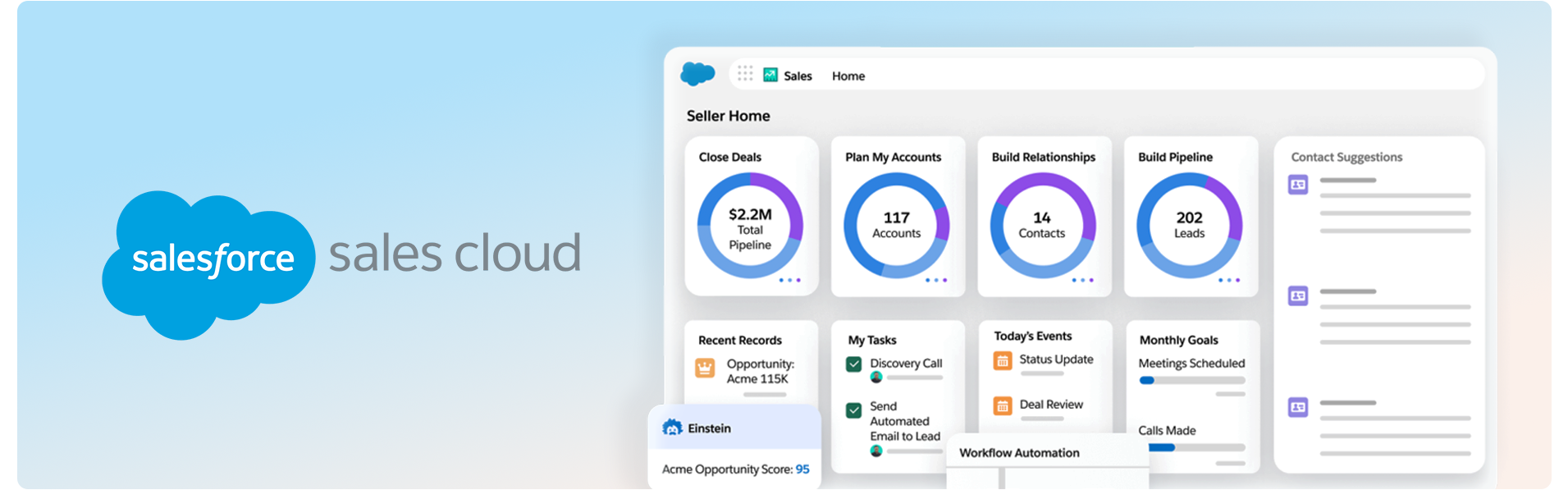
Salesforce is the system of record. Every sales operation, from startups to enterprises, builds on it. For sales managers specifically, Salesforce provides the visibility infrastructure that everything else connects to.
What It Is
Salesforce Sales Cloud is a CRM platform where opportunities, accounts, and activities live. It’s where your pipeline exists—at least, where it’s supposed to exist.
Core Functionality
Sales managers use Salesforce for pipeline reporting and forecasting. You build dashboards that show deals by stage, close date, and probability. You track rep activity—calls logged, emails sent, tasks completed. You can segment pipeline by product line, account segment, or rep and watch which segments are growing or at risk. You configure forecast categories (Omitted, Pipeline, Commit, Closed) and ask reps to assign confidence levels to their opportunities.
The platform gives you a reporting interface where you can build custom views—deals closing this quarter by stage, opportunities in certain industries, accounts at risk of churn. For many managers, a well-built Salesforce dashboard is the single source of truth for pipeline health.
The Limitation
Salesforce dashboards show beautiful charts. The problem is what feeds them.
If reps aren’t updating opportunities with complete information—current stage, next steps, decision-maker sentiment, competitive threats, budget discussions, timeline drivers—your pipeline report is fiction. A dashboard displaying 60 opportunities worth $15M doesn’t mean you’re forecasting $15M. It means you’re forecasting whatever is actually current in those opportunities. Often, that’s much less.
This is why why CRM adoption fails. Reps see data entry as administrative burden, not strategic value. In the field, between meetings and calls, the last thing a rep wants to do is sit in Salesforce and type notes. They’ll do it eventually—maybe at the end of the week, maybe during a forecast call, maybe never. By then, the intelligence is stale and the details are foggy.
Salesforce is perfect architecture for visibility. The problem is the quality of what’s being recorded into it.
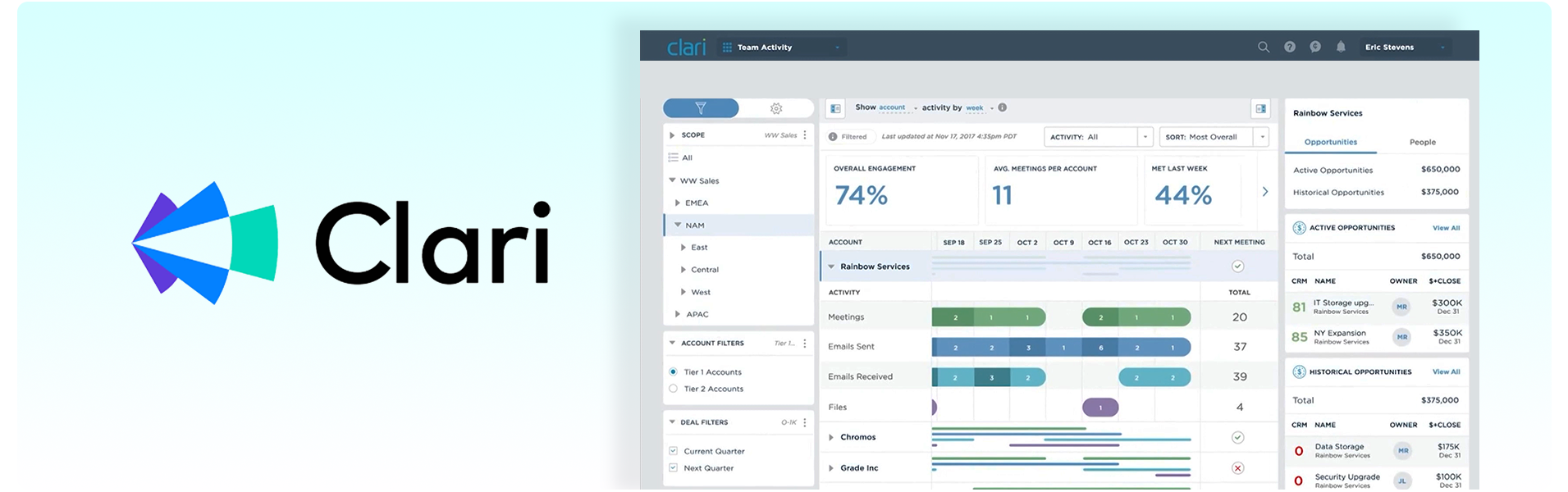
If Salesforce is your system of record, Clari is your fortune teller. It’s the tool that takes the data living in Salesforce and applies AI to surface patterns, risks, and predictive insights.
What It Is
Clari is a revenue operations platform built specifically for sales teams. It connects directly to your Salesforce data and analyzes it in real time, looking for signals of deal health, progress, and risk.
Core Functionality
Clari’s headline feature is AI-powered forecasting. Instead of relying on rep gut feel or probability percentages, Clari analyzes CRM activity data—how frequently deals are being updated, what kinds of activities are logged, how quickly deals move through stages—and uses those signals to predict which deals will close and which won’t.
The platform also offers pipeline inspection, where you can zoom into individual deals and see risk scoring. Is a deal stalled? Clari flags it. Is a deal slipping in timeline? Clari catches it. It surfaces competitive intelligence trends, identifies which reps have the highest close rates on certain deal types, and suggests coaching moments.
For many teams, Clari’s automated forecast calls are the weekly routine—the system emails your forecast with predictions, and managers trust it more than rep submissions.
The Limitation
Clari’s AI is genuinely impressive. The problem is it can’t fix bad input.
Clari makes predictions from CRM data. If your rep hasn’t updated an opportunity in two weeks, if notes are sparse, if decision-maker information is missing, Clari’s sophisticated algorithms are doing sophisticated guessing. It can detect activity patterns, but it can’t replace the intelligence that should be in the CRM in the first place.
If your organization has 40-50% field completeness, you’re paying $50K-150K annually for AI predictions based on half-complete information. That’s the $50K question: How confident are you in predictive analytics built on incomplete data?
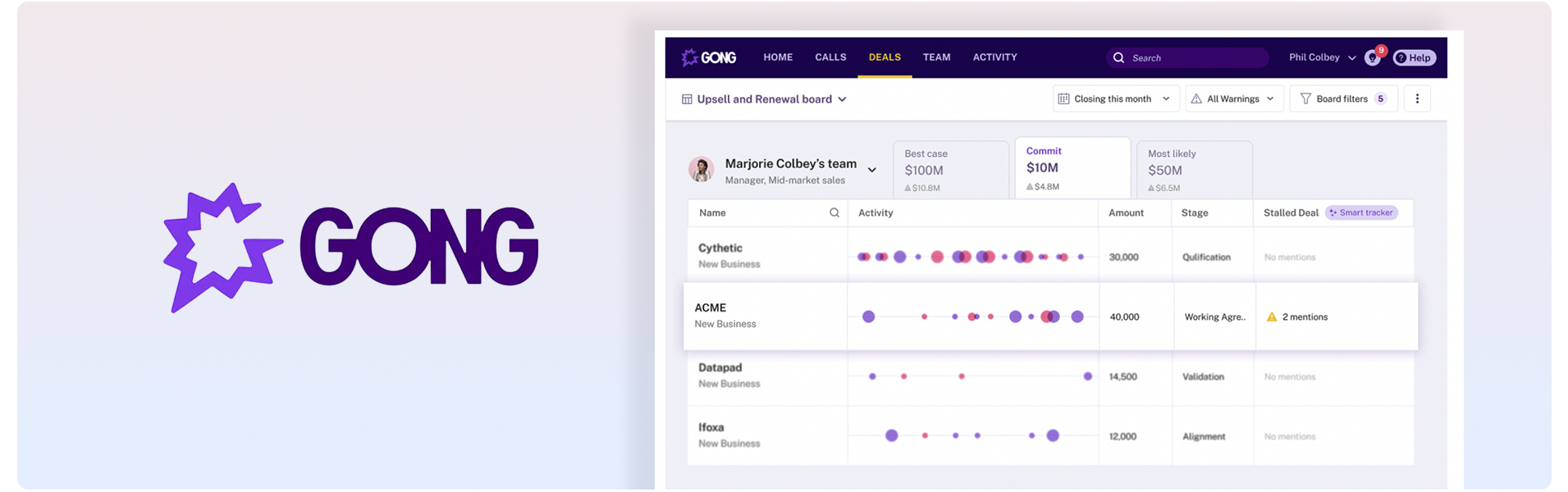
The final pillar of the sales manager stack is Gong, a conversation intelligence platform that records, transcribes, and analyzes sales calls.
What It Is
Gong captures and analyzes customer conversations. It’s designed to help sales managers understand what’s happening in deals by hearing (and reading transcripts of) what’s actually being discussed.
Core Functionality
For sales managers, Gong provides several capabilities. First, it analyzes conversations across your team to identify patterns—which objections appear most frequently, which rep behaviors correlate with wins, which companies use certain language. It highlights coaching moments: “Your rep should have addressed the budget concern differently” or “Here’s how your top performer handled this objection.”
Second, it provides deal-specific intelligence. For large deals, you can read the call transcript or watch the recording and understand exactly what was discussed, what commitments were made, and what objections remain. Third, it feeds into skill development—you can identify best practices and use Gong recordings to coach the team on specific competencies.
For many managers, Gong is the way you maintain visibility into deals without being in every call.
The Limitation
Gong provides incredible coaching insights from recorded calls. The limitation is what it can’t record.
Gong works beautifully for virtual calls—which now represent about 60% of sales conversations. But for field sales, in-person presentations, coffee shop meetings, and dinners where deals are discussed, Gong has no visibility. The insights Gong provides are powerful. But for teams with field components, you’re coaching based on incomplete intelligence—only the virtual calls, not the in-person conversations where the relationship and trust are often built or broken.
Here’s what a typical week looks like with the three-tool stack:
Monday morning: Clari sends your forecast. You review it alongside Salesforce, looking for deals that seem off. You note 3-4 opportunities that look risky based on Clari’s analysis, even though reps flagged them as “Commit.”
Tuesday: You dive into Gong, searching for calls from deals Clari flagged. You find a call from last week where the prospect sounded hesitant about timeline. You pull the rep in for a coaching conversation about how to re-engage.
Wednesday: You spend an hour in Salesforce building custom reports—which reps are hitting activity targets, which pipeline is newest, which accounts look at risk of churn.
Friday: Forecast call with the team. Reps update opportunities in real time on the call. You ask questions about deals that haven’t been updated in a week. You notice that one rep’s pipeline looks healthy in Salesforce but Clari is skeptical. You dig in. Turns out, 3 of those deals haven’t been updated in 10 days. The real status is unknown.
The gaps in this routine are visibility gaps. And those gaps are expensive.
Let’s conduct an audit of your sales tech stack:
Question 1: What percentage of opportunities have complete information?
By “complete,” we mean: next steps documented, decision-maker sentiment recorded, competitive situation understood, budget discussions captured, timeline drivers identified, and current stage justified. Industry reality for field sales teams: 40-50% of opportunities meet this standard. The other 50-60% have enough information to exist in Salesforce but not enough to make an intelligent forecast.
Question 2: How delayed is your CRM data?
Meetings happen Monday. Reps get back to the office and think about entering data Tuesday. They might start typing Wednesday. By Friday, they’re finally caught up. Industry reality: 2-5 days of delay between customer interaction and CRM record.
Question 3: What percentage of customer conversations are actually captured?
Gong records virtual calls. But what percentage of your team’s selling happens on Zoom vs. in person? If your team does 40% field sales, Gong is only capturing 60% of the conversation intelligence. Industry reality: 10-20% of total customer conversations are captured and analyzed.
Here’s a scenario that happens every week in sales organizations:
Monday morning, a rep has four customer meetings. In each conversation, there’s critical movement: a budget owner signs off, a decision-maker expresses concern, a competitor is mentioned, the timeline gets pushed. The rep knows exactly what happened—she was there.
Tuesday, the rep is in back-to-back internal meetings and doesn’t get to her notes.
Wednesday afternoon, she’s finally at her desk. She tries to remember four conversations. The details have faded. She writes something like “Good call, moving forward” in Salesforce. She doesn’t remember the exact budget number mentioned. She’s not sure if that concern about integration was a deal-killer or a standard question. She doesn’t capture that a competitor was mentioned.
Thursday morning, Clari generates the forecast. The algorithm looks at this rep’s four opportunities. “Last activity was Wednesday. Notes are vague. Probability: lower than rep’s assessment.” Clari flags three of them as at-risk.
Thursday’s forecast call: You ask the rep about these flagged deals. The rep says “No, they’re actually solid. We’re moving forward.” But she can’t give you specifics because the details in Salesforce are sparse. You don’t know if she’s being optimistic or if Clari is being pessimistic. So you average them out and forecast at a lower number.
Friday, one of those deals—which the rep was confident about—slips by two weeks because a key decision maker is out of office. Clari didn’t flag this because the rep didn’t capture it. Your forecast was wrong.
The cascade failure looks like this:
The statistics bear this out: Sales leaders with high CRM data quality (85%+ completeness) forecast within ±10%. Leaders with poor data quality (40-50% completeness) see forecast variance of ±30-40%. That variance, compounded across a team, is the difference between hitting plan and missing it.
Your analytics stack—Salesforce, Clari, Gong—represents a significant investment. But if the data feeding these tools is incomplete or delayed, you’re paying for expensive guesses instead of expensive insights.
Here’s the insight most sales organizations miss: You don’t need better analytics tools. You need better data going into your analytics tools.
Voice-to-CRM isn’t another analytics platform. It’s a data quality layer. It sits between the customer conversation and your CRM, capturing the intelligence from that conversation and getting it into Salesforce automatically, in real time.
Here’s how it works in practice:
Without voice-to-CRM, the scenario above plays out as described. Rep has meetings, tries to remember details later, Salesforce is incomplete, your analytics tools work with bad data.
With voice-to-CRM, here’s what happens:
Monday morning, the rep has four customer meetings. After each meeting—or even during the drive to the next meeting—the rep spends 90 seconds capturing voice notes. “We discussed budget of $150K. The CFO is the final decision-maker. They’re evaluating us and one competitor. Timeline is 6 weeks. Next step is a technical demo Tuesday.”
That 90-second voice note is automatically transcribed and ingested into Salesforce. The opportunity updates in real time. By noon Monday, all four opportunities have complete, current information captured.
Thursday’s forecast call: You look at Clari’s forecast. The algorithm has analyzed these four opportunities. Each has complete context, recent activity, clear next steps. Clari’s confidence is high. Your forecast is accurate. The rep confirms: “Yep, that’s exactly where we are.”
Friday, that decision-maker being out of office would still happen. But because Clari had complete information Thursday, you already knew the deal was solid and the timeline was 6 weeks. When it slips to 8 weeks Friday, it’s an adjustment you expected, not a surprise that derails your forecast.
Real-time pipeline visibility means real-time forecast accuracy.
Real-time pipeline visibility: You walk into a forecast call and Salesforce is current. You’re not asking reps “Wait, what’s the status?” You’re asking “Here’s what you told the customer Tuesday. How do we move it forward?”
Accurate forecasting: With complete data in Salesforce, Clari’s predictions are high-confidence. You forecast with ±10% variance instead of ±30-40%. At a $5M quarterly quota, that difference is $500K in predictability.
Better coaching: Gong analyzes recorded calls. But voice-to-CRM captures the rep’s own summary of what happened. Combined, you have both the customer perspective (Gong) and the rep’s perspective (voice-to-CRM) on every deal. That’s complete intelligence for coaching.
Forecast calls that don’t suck: You know what the biggest complaint is about forecast calls? They’re theater. Reps defend their numbers. Managers dig for “truth.” No one is learning. But when Salesforce is complete and current, forecast calls become strategic conversations: “Here’s where we are. Here’s what we need to do to win this.” Theater becomes strategy.
Let’s do the arithmetic.
Your current stack: - Salesforce: approximately $200/seat/month for managers = $2,400/year per manager - Clari: $50K-100K/year (let’s use $75K) - Gong: $50K-80K/year (let’s use $65K) - Total: approximately $140K-145K/year
With 40-50% CRM completeness, you’re realizing approximately 35-40% of these tools’ potential. Your actual value: $49K-58K.
Now add voice-to-CRM: $1,800/year per rep. For a team of 10 reps: $18,000 annual investment.
With voice-to-CRM, CRM completeness jumps to 85-95%. Your analytics tools now work with complete data. Realized value from your stack: 85-90%. Your actual value: $119K-130K.
Additional value unlocked: $70K-80K. For an $18K additional investment: 389-444% ROI.
Plus: Forecast variance improves from ±30-40% to ±10%. On a $5M quarterly quota, that’s the difference between missing forecast by $1.5M and hitting it within $500K. That’s the difference between making your number and not.
For a management team, that predictability compounds. One accurate forecast quarter becomes two becomes four. Your board trusts your forecast. Your team hits a plan. Bonus seasons are less painful.
This is the ROI managers care about: better forecasts, easier coaching, fewer surprises, predictable revenue.
And the tool that enables it all? Voice-to-CRM. The foundation layer that makes your $140K analytics stack actually work.
Marcus manages a team of 12 enterprise sales reps at a mid-market software company. His team carries a $12M annual quota.
Monday morning: Clari sends the forecast. Marcus reviews it in Salesforce. Every opportunity updated since Friday is current. He sees 47 deals in the pipeline worth $14.2M. Clari’s AI has analyzed all of them. Predicted close is $12.8M for the quarter. Marcus doesn’t question the numbers—he knows they’re built on complete data.
Tuesday: Marcus listens to a Gong recording of a call from Friday. The rep did a great job re-engaging a stalled opportunity. Marcus also checks the voice summary the rep captured after the call: “Budget approved at $120K. Legal review is the remaining blocker. Decision expected Thursday.” Marcus has both the conversation insight and the rep’s takeaway. He makes a mental note to point out the re-engagement technique in next week’s coaching call.
Wednesday: One of Marcus’s reps has a customer call with a $500K opportunity. After the call, the rep captures 90 seconds of audio: “Strong interest in our platform. Three decision-makers on the call. Budget is available in Q2 but there’s internal pressure to fix it sooner—meaning Q1. Timeline is tight. Next step is trial setup Monday.” The opportunity updates in Salesforce immediately. Marcus sees it that afternoon and knows exactly where they stand.
Thursday morning: Forecast call with the team. Marcus opens Salesforce. Every opportunity has complete information. He spends 45 minutes on strategic conversations: “Here’s what we need to do to close these deals.” No theater. No defending numbers. No “Wait, what’s the status?” Just pure strategy. One rep had a deal slip by two weeks due to a holiday; Marcus saw it coming because the next-step timeline was captured Monday. They already adjusted the forecast.
Friday: Marcus is confident in his forecast to the CFO. Variance is tight. Calls next week are crisp because he knows exactly what the next step is on every opportunity. The week is clean.
The difference from the typical sales manager week? Marcus has complete visibility. His team’s intelligence is captured at the moment of truth, not reconstructed days later from fading memory. His $140K analytics stack isn’t working with incomplete data; it’s working with reality.
Companies with successful CRM strategies share one trait: they treat data capture as infrastructure, not admin.
Explore Hey DAN’s full capabilities to understand what complete data capture looks like for a modern sales manager.
Stop paying for expensive predictions based on incomplete data.
Your sales manager stack is powerful. Salesforce is a robust system of record. Clari applies cutting-edge AI to CRM data. Gong reveals what’s happening in conversations. These tools represent years of product development and significant annual investment.
But they’re all downstream from one thing: the quality of data in your CRM.
If your team has the industry-standard problem—40-50% field completeness, delays between meeting and CRM entry, sparse notes—then you’re investing $140K+ annually in tools designed to work with complete data, while feeding them incomplete data. Your expensive analytics stack generates expensive guesses.
The fix isn’t a new analytics platform. It’s the foundation layer that ensures your CRM is complete and current.
Voice-to-CRM captures the intelligence from customer conversations at the moment they happen. Real-time intelligence flows into Salesforce. Your analytics tools work with complete data. Your forecasts are accurate. Your team hits quota.
For sales managers responsible for $5M+ quarterly revenue, predictability is worth everything. The investment in voice-to-CRM isn’t a cost—it’s the foundation that makes your entire tech stack actually work.
Learn how voice-to-CRM works and why it’s the foundation your analytics stack needs. Explore the full capabilities to understand how real-time data updates transform visibility and forecasting. Dive into the data quality problem and understand why CRM adoption fails—then learn from companies with successful CRM strategies. And if you have questions about implementing a complete sales management stack, the FAQ and support hub have answers.
The $140K you’re already investing in analytics tools deserves to stand on solid ground. Voice-to-CRM provides that ground.


