
Medical and pharmaceutical sales live in a different world than most industries. Every conversation with a healthcare professional is regulated. Every sample distributed requires documentation. Every clinical discussion needs to be recorded. Every adverse event mentioned must be flagged. The regulatory stakes aren’t just high — they’re existential. Incomplete compliance documentation doesn’t just mean lost deal context. It means regulatory liability, audit findings, and potential enforcement action.
This creates a unique problem for medical sales reps: they must be excellent field sellers while simultaneously maintaining meticulous compliance records. The result is a documentation burden that typically consumes 30-40% of a rep’s workday, according to life sciences industry research. That’s not a minor friction point. That’s rep burnout. That’s why your best performers leave the industry.
The right technology stack can change this. Most medical sales teams use three core tools: Veeva CRM for compliance-first data management, Salesforce Maps for territory and HCP targeting, and Rilla for in-person call recording. These three tools are solid. But they leave a critical gap — the gap between what Rilla records and what Veeva requires. This is where voice-to-CRM technology bridges the divide, creating a complete compliance architecture that doesn’t sacrifice rep efficiency.
Here’s the stack that actually works for life sciences field sales, and the solution that makes it sustainable.
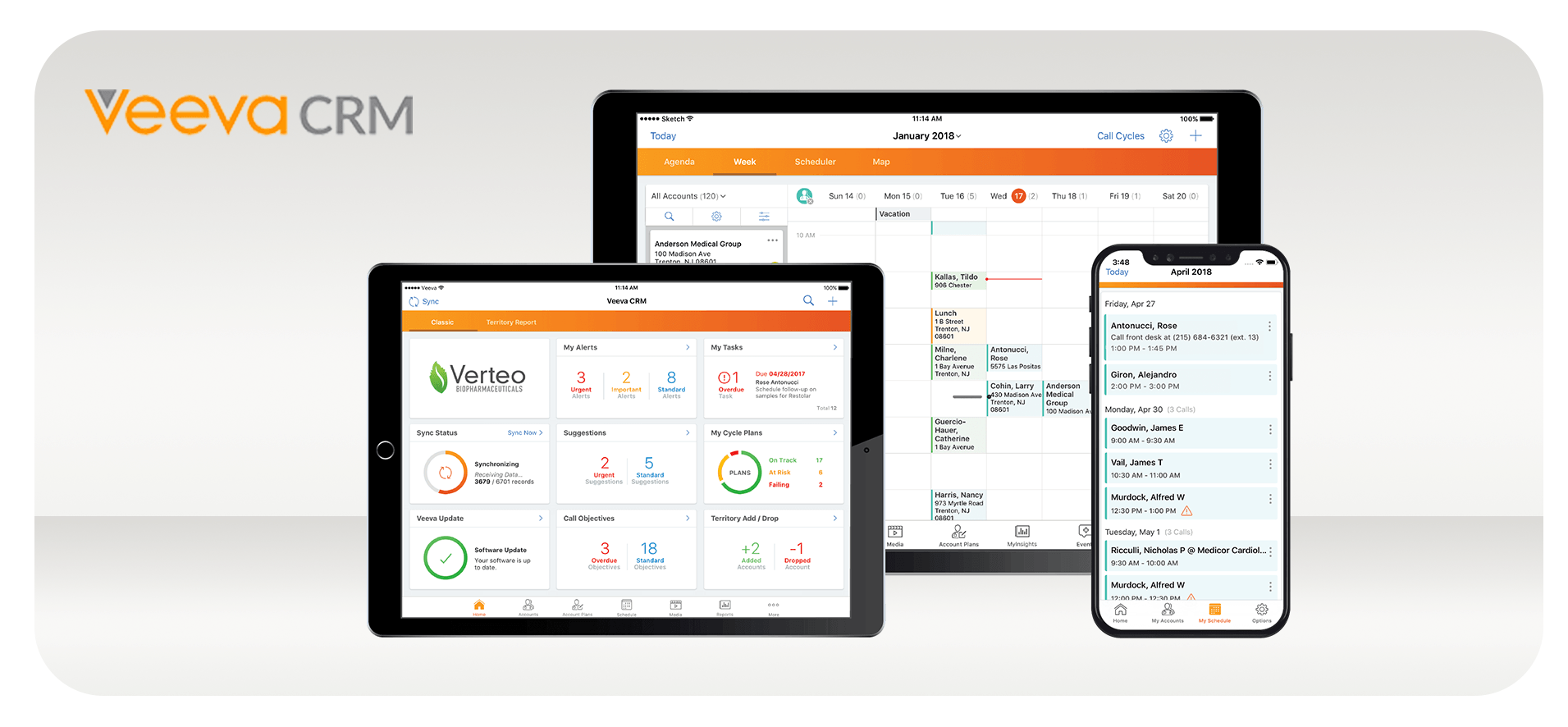
Veeva CRM isn’t a generic CRM adapted for pharma. It’s purpose-built for life sciences compliance. That distinction matters enormously.
What It Is
Veeva is the de facto CRM standard in pharmaceutical and medical device sales. It’s designed from the ground up to handle FDA regulations, HIPAA requirements, and the specific documentation protocols that life sciences demands.
Core Functionality
Veeva CRM includes several capabilities that generic CRMs can’t deliver. It manages Healthcare Professional (HCP) data with privacy compliance built into the architecture. It tracks sample distribution with full audit trails, which is critical for regulated product management. It includes call reporting templates that align with medical affairs and regulatory requirements. It supports territory management with compliance-aware workflows. And it integrates with pharma headquarters systems so that compliance reporting flows upstream automatically.
For a rep visiting a hospital or clinic, Veeva is where everything gets documented: which HCPs were seen, what products were discussed, how many samples were distributed, what clinical questions were raised, whether any adverse events were mentioned, and what follow-up is required. The structure is rigid because the compliance requirements demand rigidity.
The Limitation
Veeva CRM is purpose-built for life sciences compliance — it handles everything regulatory requirements demand. But it still requires every HCP interaction to be manually documented. For a rep completing 6-8 visits per day, that documentation burden accumulates quickly. Veeva manages the compliance structure. It doesn’t reduce the time cost of populating it.
This is where reps hit their wall. After a long day of field visits, they sit down to their evening documentation session. The clinical details are fresh, the emotional energy from conversations is fading, and the documentation task stretches in front of them — 20 minutes per HCP visit multiplied by six to eight visits. That’s two to two-and-a-half hours of data entry every single evening.
When reps dread the documentation task, they deprioritize it, delay it, or skip details. That’s when Veeva data becomes incomplete. Data quality suffers. Compliance coverage weakens. And the tool that was supposed to protect regulatory standing becomes a liability instead — a pattern that explains why CRM adoption fails even in regulated industries that invest heavily in the right platforms.
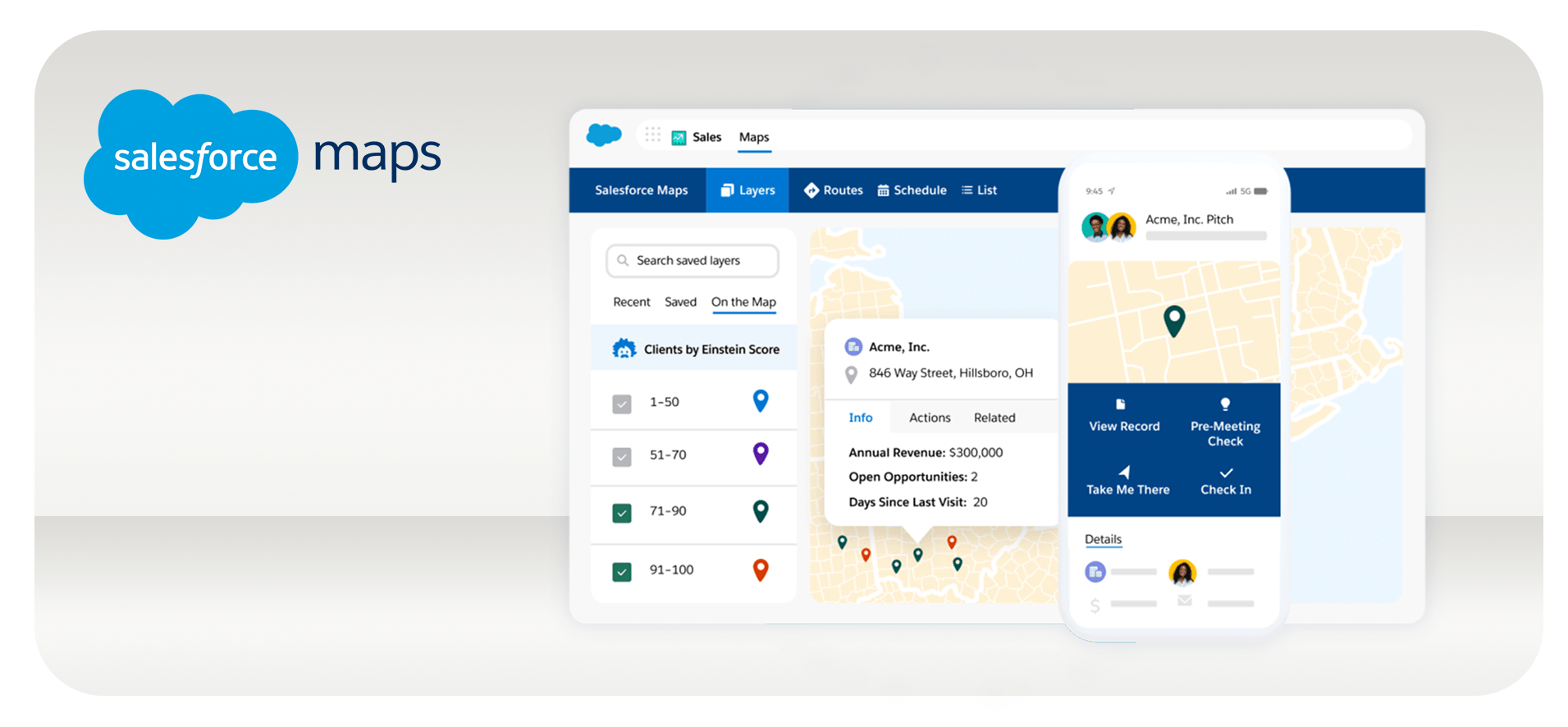
Veeva manages the data. Salesforce Maps manages the geography.
What It Is
Salesforce Maps is territory and route planning software designed for field sales organizations. In a life sciences context, it visualizes your HCP universe and optimizes your field strategy.
Core Functionality
Maps displays hospitals and clinics on a visual territory map. It layers in HCP data so you can see which doctors are in which locations. It calculates optimal routes for your daily visits, so you’re not criss-crossing a region unnecessarily. It tracks visit frequency to ensure you’re hitting the right accounts with the right call frequency. It identifies white space — HCPs you’re not calling on who should be in your strategy.
For a medical sales rep, this means better field planning. You see your territory geographically. You understand which HCPs are clustered, which ones you’re neglecting, which ones are being over-covered. You optimize routes to reduce driving time and increase field time. You plan your day so that each visit follows logically from the previous one.
The Limitation
Salesforce Maps is excellent at answering the question: “Where should I go today?” It optimizes routes. It identifies high-value accounts. It tracks visit frequency. But it doesn’t answer the question: “What happened when I got there?”
Route planning and territory management are solved problems in field sales. Salesforce Maps solves them well. But it tracks geography, not conversation. After you complete a field visit, Salesforce Maps doesn’t know what the HCP said about your product, whether they showed interest, what objections they raised, whether they mentioned adverse events, or what your next steps should be. That information lives elsewhere.
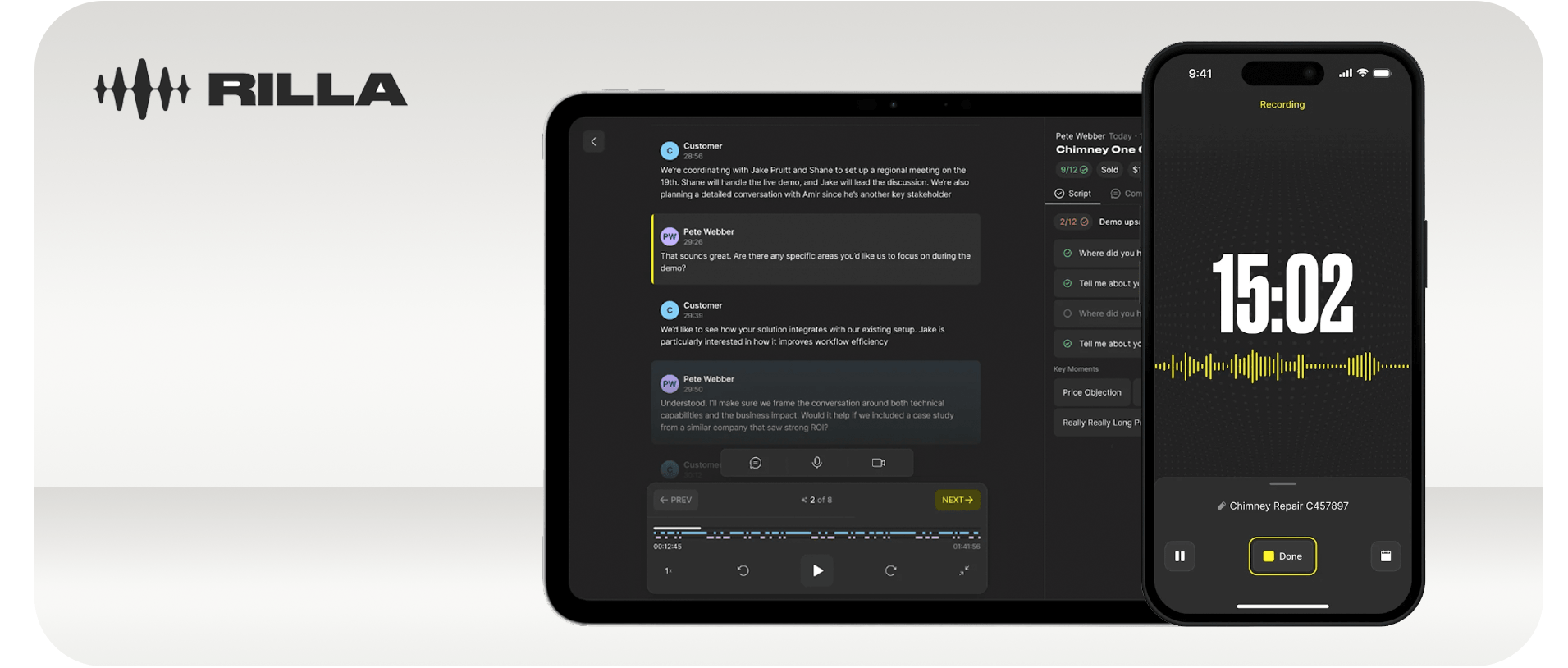
The field visit is the core of medical sales. Rilla captures it.
What It Is
Rilla is a conversation recording and analysis platform designed specifically for in-person field sales. It records face-to-face meetings, transcribes them, and analyzes them for coaching and compliance documentation.
Core Functionality
Rilla works by recording the audio from in-person meetings with HCPs. The rep places their phone on the table, the meeting happens naturally, and Rilla captures the full conversation. After the meeting, Rilla transcribes the conversation. It can analyze the conversation for coaching — identifying effective pitch moments, objection handling, discovery questions. And it creates a record of what was discussed, which is critical for compliance purposes.
In a life sciences context, Rilla’s primary value is compliance documentation. In regulated medical sales, you need to document what was actually discussed. Rilla provides that documentation in its purest form: the actual recorded conversation.
The Limitation
Here’s the essential limitation: Rilla solves the capture problem. It records the conversation. But an audio file is not Veeva CRM data.
After each HCP visit, a rep still needs to:
Rilla captures what happened. A human still has to translate that into compliant CRM documentation. And that translation process is exactly where the rep’s evening disappears.
This is why most medical sales teams with Rilla still face the documentation burden. They have the audio record. But they don’t have the structured data. They have the conversation. But they don’t have the database entry.
Understanding how these three tools interact reveals both their value and their gap.
A typical day starts with Salesforce Maps. You review your territory, identify the six HCPs you’re visiting, and optimize your route. Veeva shows you the call objectives for each HCP — what you need to accomplish at each call. You know which products are in your talk track, which samples you’re carrying, and which regulations apply to each conversation.
You drive to the first HCP office. Rilla records the meeting. The conversation flows naturally. You discuss the product, answer clinical questions, gauge interest, and distribute samples.
Meeting ends. You walk to your car. Now the documentation process begins.
Without voice-to-CRM technology, here’s what happens: You sit in your car for 20 minutes typing notes into Veeva. You document the HCP details, the products discussed, the samples distributed, the clinical questions raised, any adverse event concerns, and the next steps. You do this six times. Six visits, six times sitting in the car, six times 20 minutes of typing on your phone or laptop. That’s two hours of the afternoon.
Then you drive to the next HCP. But now you’re mentally tired from documentation. The clinical nuance from the first call is fading. The emotional engagement with each HCP is draining instead of energizing. By the end of six visits, you’ve spent more time documenting than selling.
This is the heart of the problem: the best medical reps leave the industry because the documentation burden is unsustainable.
Consider a realistic field day. Maria, a pharmaceutical rep in the Midwest, visits six HCPs in her territory. Each visit is a substantive conversation — clinical discussion, sample distribution, addressing objections, planning follow-up. Each visit needs to be documented in Veeva with full compliance detail.
After visit one, she sits in her car and documents: the HCP’s clinical interest in the product, specific concerns they raised about drug interactions, the number of samples provided, their request for additional literature, and the date of the next visit. That’s 20 minutes.
After visit two, another 20 minutes. Different HCP, different details, same documentation burden.
By visit six, Maria is exhausted. She’s been driving, engaging, selling. Now she faces six times 20 minutes of typing — 120 minutes total. She’s either going to sacrifice the evening, cutting into personal time that should be recovery, or she’s going to deprioritize the documentation, entering incomplete notes that compromise data quality and compliance coverage.
This is the burnout cycle. The regulatory nature of medical sales demands complete documentation — yet the CRM data entry burden is one of the industry’s most persistent challenges. The volume of field visits creates documentation burden. The documentation burden eats the evening. The personal sacrifice accumulates. The best reps leave.
And from a compliance perspective, there’s a critical risk here. In most industries, incomplete CRM data means lost deal context. That’s unfortunate but manageable. In life sciences, incomplete documentation means compliance risk. If an adverse event is mentioned and not documented, if a clinical discussion isn’t recorded in Veeva, if sample distribution isn’t logged, you’ve created a gap in your regulatory file. That gap is what regulators find during audits.
The calculation at the bottom of this gap is simple: 120 minutes of documentation per day × 5 days per week = 10 hours per week of post-field paperwork. Over a year, that’s 480 hours per rep — roughly 12 full workweeks — spent on the documentation that should support selling, not replace it.
The problem isn’t the tools. Veeva, Salesforce Maps, and Rilla are all doing their jobs. The problem is the gap between them: what Rilla records and what Veeva requires.
This is where voice-to-CRM technology fundamentally changes the equation.
Voice-to-CRM systems like Hey DAN are designed to bridge exactly this gap. They’re HIPAA-compliant with Business Associate Agreements (BAAs) available. They use SOC 2 certification and secure data handling protocols. They’re built specifically to capture Protected Health Information (PHI) safely.
After each HCP visit, instead of sitting in the car for 20 minutes typing, a rep speaks a 90-second structured note. The voice note captures everything: the HCP’s clinical interest and specific concerns, the products discussed in detail, how many samples were distributed, any adverse events mentioned, any clinical questions that need escalation, and the specific next steps for follow-up.
That voice note is captured securely. It’s transcribed. It’s structured into Veeva CRM fields automatically. The HCP record is updated. The product discussion is logged. The samples are documented. The adverse event flag is set if needed. The next call objective is created.
The entire process takes 90 seconds of the rep’s time.
From a compliance perspective, you now have a complete chain: Rilla has the full audio record of the actual conversation (what was really said). Hey DAN has the structured CRM entry (what needs to be documented). Together, they create complete compliance coverage. You have the conversation record for compliance review. You have the structured data for auditing. You have the audit trail for regulatory verification.
Here’s how the complete stack works:
Rilla records the face-to-face meeting with the HCP. That audio is your compliance record — your documentation that the conversation actually happened and what was actually discussed. It’s invaluable for coaching, for quality assurance, and for regulatory defense.
Hey DAN captures the structured intelligence from that conversation. Explore its full capabilities to see how it handles HIPAA-compliant medical field documentation. The rep speaks the clinical details, the product discussion, the sample distribution, the adverse event flags. That gets transcribed and structured into Veeva fields automatically.
Together, they’re not redundant. They’re complementary. The recording provides the evidence. The structured entry provides the documentation. The compliance architecture is complete.
You don’t have to choose between compliance and efficiency. Hey DAN provides both.
Consider Maria’s Tuesday again, but now with voice-to-CRM integrated.
Before: Maria completes 6 HCP visits. Each visit is followed by a 20-minute documentation session in her car. By the time she completes all six visits and their documentation, she’s spent 10 hours in the field. That’s a full workday consumed by field visits and documentation, with evening personal time sacrificed.
After: Maria completes 6 HCP visits. After each visit, she speaks for 90 seconds capturing the critical details. Veeva fields auto-populate from the voice note. By the end of the six visits, she’s spent 8 hours in the field (6 hours visiting, 9 minutes total voice capture). Her documentation is complete. Her Veeva data is accurate. She has a personal evening.
More importantly, the time saved means showing capacity. With two extra hours in the afternoon, Maria can fit in one additional HCP visit. That’s five additional visits per week, roughly 250 additional visit opportunities per year. Even at a conservative conversion rate, that translates to additional transactions and additional revenue.
Let’s be precise about the value:
Without voice-to-CRM: - Manual documentation: 20 minutes per HCP visit - 6 visits per day = 120 minutes per day - 5 days per week = 600 minutes per week = 10 hours per week - Annual documentation time: 480 hours per rep
With voice-to-CRM: - Automated voice capture: 90 seconds per HCP visit - 6 visits per day = 9 minutes per day - 5 days per week = 45 minutes per week - Annual time: 36 hours per rep - Annual time savings: 444 hours per rep
At a blended rate of $75 per hour (salary, benefits, allocation): that’s 33,300 dollars of value per rep annually.
Voice-to-CRM system cost: approximately 1,800 dollars per year.
Return on investment: 1,750 percent.
Here’s how the three-tool stack compares to the complete stack with voice-to-CRM:
The most important metrics are data completeness and consistency. When documentation happens manually after a long field day, quality suffers — which is precisely why the most successful CRM strategies prioritize immediate, effortless capture over end-of-day reconstruction. Fatigue leads to incomplete notes. Similar conversations blur together. Details get lost. When documentation happens immediately after each visit via voice note, consistency is much higher. Compliance documentation is more reliable. Regulatory defensibility is stronger.

Maria manages a six-state territory covering twelve major metropolitan areas. Her typical Tuesday includes visits to six healthcare professionals: a hospital clinic chief, a community practice group, two individual practitioners, and two nurse practitioner-led clinics.
She starts her day with Salesforce Maps. It’s optimized her route so the six locations flow geographically. Veeva shows her the call objectives for each HCP — which products need emphasis, what clinical evidence resonates with each provider, which samples are appropriate.
First call: hospital clinic, 8:30 AM. The chief asks about dosing in hepatic impairment. Maria addresses it with the clinical data. They discuss two products. She distributes samples. The call takes 45 minutes.
As she walks to her car, instead of sitting down for 20 minutes of typing, she speaks: “HCP expressed strong interest in product A, specifically asked about hepatic dosing, which I addressed with the published data. Requested five sample packs of product A, quantity distributed and lot numbers logged. Adverse event discussion: none raised. Next call: three weeks, requested literature on hepatic impairment subset.”
That voice note, 90 seconds, gets captured into Veeva automatically. The call is documented. The samples are logged. The next objective is created.
Second call: 9:30 AM, community practice. Different products, different clinical discussion, different sample needs. Another 90-second voice note. Another completed documentation.
By 2:30 PM, all six calls are complete. All six calls are documented. Veeva is fully populated. Rilla has the audio records. Maria has her personal afternoon back. She has a complete audit trail for regulatory review. She hasn’t sacrificed data quality for efficiency — she’s improved both simultaneously.
This is the sustainable medical sales workflow.
Medical and pharmaceutical sales are fundamentally harder than most industries because the regulatory requirements demand meticulous documentation. This documentation burden is unavoidable. But it shouldn’t consume your reps’ evenings or compromise data quality.
The right technology stack makes it manageable. Veeva CRM provides the compliance structure. Salesforce Maps optimizes territory efficiency. Rilla captures the actual conversations. And voice-to-CRM technology structures those conversations into the documentation that Veeva requires — without requiring your reps to spend hours typing after field visits.
You can maintain complete regulatory compliance without asking your reps to sacrifice personal time. You can improve data quality by capturing information immediately instead of from fading memory. You can reduce burnout by removing the documentation tax.
The life sciences sales stack that works is Veeva, Salesforce Maps, Rilla, and voice-to-CRM. It’s the architecture that makes regulated field sales sustainable.


