Why your CRM and enablement platform are solving different problems—and where that gap creates friction
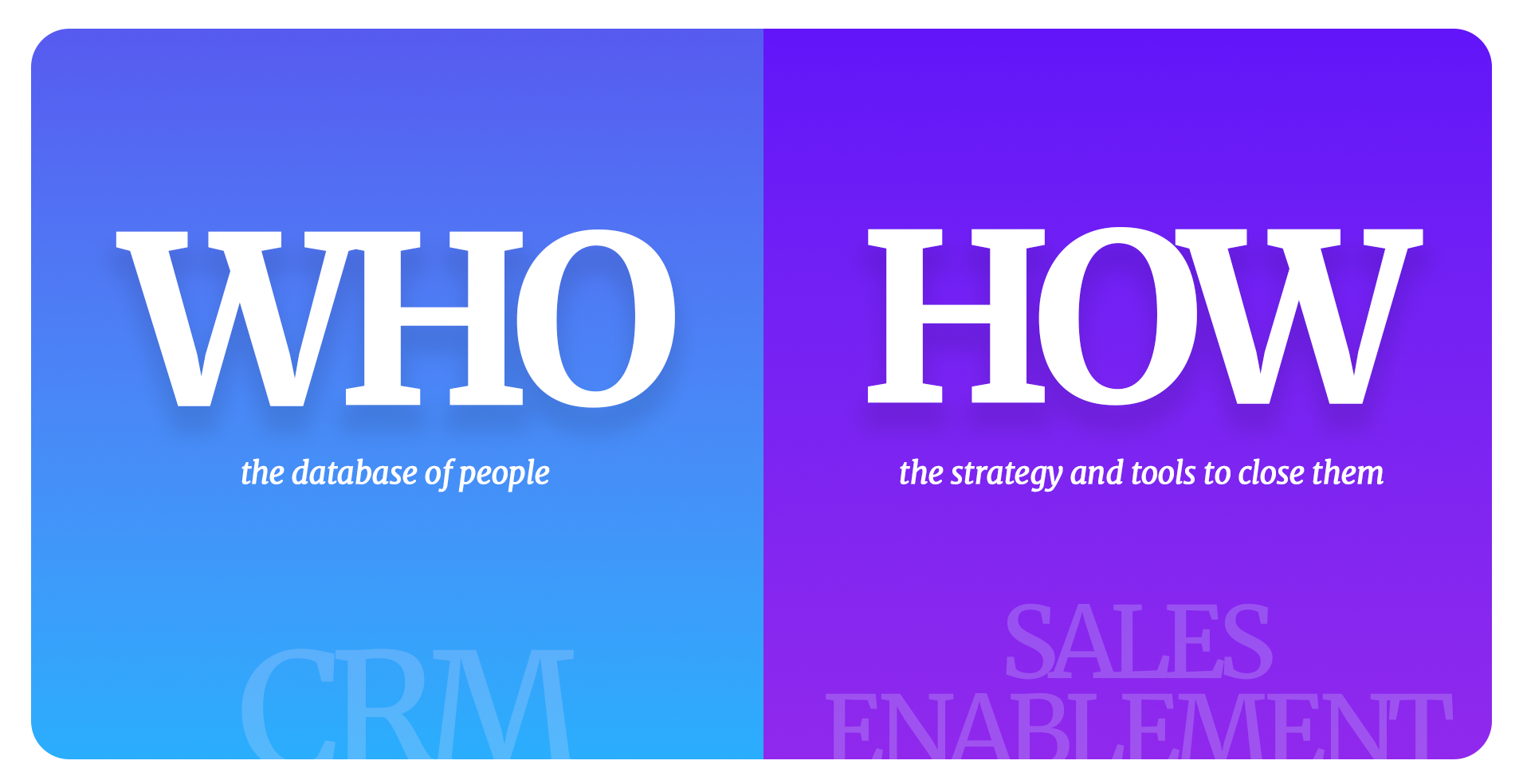
Organizations spend heavily on both sales enablement platforms and CRM systems, often treating them as separate purchases from separate vendors. The assumption is that enablement arms reps for conversations, and CRM records the outcome. Simple handoff.
In practice, they operate in isolation. A rep uses an enablement platform to prepare for a call. Then they have a conversation. Then they use a CRM to log what happened. Each system sees only its slice of the sales process. Neither system knows the full context.
This disconnect creates friction: extra steps, repeated information entry, incomplete records, and lost context. More importantly, it creates a false assumption — that CRM and enablement together add up to a complete sales operating system. They don't. There's a critical gap in the middle.
Understanding this gap is the first step to fixing it.
Sales enablement is the practice of equipping sales reps with the tools, content, knowledge, and skills they need to move a deal forward. It's preparation-focused.
In practice, sales enablement covers:
The core purpose: when a rep sits down before a call or steps into a discovery meeting, they should have everything they need. No scrambling. No looking things up. Everything is prepped and available.
Modern enablement platforms (Seismic, Highspot, Klootz, and others) centralize this in a single destination. Reps can search for content, find the right resource, see how peers are selling similar deals, and update their knowledge quickly.
A CRM is a system of record. Its core job is to store and organize information about prospects, companies, deals, and sales activities. It's a database and a framework for that data.
CRMs provide:
The core purpose: after a rep has a conversation, the CRM becomes the authoritative record of what happened. Opportunity stage, next steps, decision criteria, competitive situation, pricing discussion — all live in the CRM. Leaders use the CRM to forecast revenue, track pipeline health, and spot bottlenecks.
CRMs (Salesforce, HubSpot, Pipedrive, Microsoft Dynamics) are powerful tools for this. They're designed to store structured data, retrieve it quickly, and generate reports. But they're not designed to capture data from the chaos of real conversations.
On paper, enablement and CRM have a clean handoff: enablement preps the rep, CRM records the result. But in practice, there's friction at this boundary.
Here's what a typical rep workflow looks like:
Notice the invisible work: the rep had to be prepared (enablement), then had to become a data entry person (CRM). Two separate mindsets. Two separate systems. One human doing both.
The gap is in this translation step. Between what was learned from enablement, what was discussed in the call, and what gets recorded in the CRM, there's a conversion process. That conversion takes time, loses context, and is where data quality suffers.
Enablement solves a content problem: 'Do reps have the right information to sell effectively?' CRM solves a data problem: 'Do we have the right records to forecast accurately?'
These are different problems with different solutions.
A sales rep might use enablement to find a product ROI case study for a financial services buyer. That's content — information designed to help move the deal forward. But after the call, the CRM needs data: Did we discuss price? Is budget approved? What's the decision timeline? That's not content, it's structured information about what happened.
The link between them is the conversation, and that link is where the gap appears. Enablement prepares the rep with 'what to know.' The conversation happens. Then the rep has to decide 'what to record' and manually type it into the CRM.
A good enablement platform might help a rep understand discovery questions to ask (content). A good CRM might have fields to capture the answers (structure). But neither helps the rep move from asking the question to recording the answer efficiently.
The gap between enablement and CRM explains a frustrating pattern that sales leaders see everywhere: reps are trained, given access to good content and tools, yet pipeline data is still incomplete and stale.
The reason: CRM adoption fails not because reps reject the tool, but because the workflow feels inefficient. A rep can be fully enabled (well-prepared, confident, armed with great content) but still hate the moment they have to log the call.
Here's what happens:
But the real issue isn't reps. It's the gap. The transition from 'selling mode' (enabled, confident) to 'data entry mode' (friction-filled, cognitive switch) is too harsh. One moment you're closing, the next you're typing. The tools don't bridge that gap.
Between enablement and CRM, there's a missing layer: capture infrastructure. This is the bridge that should convert what a rep learned and what they discussed into structured CRM data, without requiring a manual translation step.
Think of it this way:
A proper capture infrastructure removes the rep from the data entry equation. Instead of the rep translating their conversation into structured data, a capture system takes the conversation (via voice, quick notes, or email) and transforms it into the data structure the CRM needs.
This is why approaches like voice to CRM exist. They sit at this intersection: taking the natural output of a conversation (voice notes) and automatically converting them into structured CRM entries. The rep stays in selling mode. The capture layer handles the translation.
With a capture layer in place, the workflow becomes: prep with enablement, have a great call, speak a brief summary, and move to the next activity. The CRM record happens automatically. No friction. No context-switch.
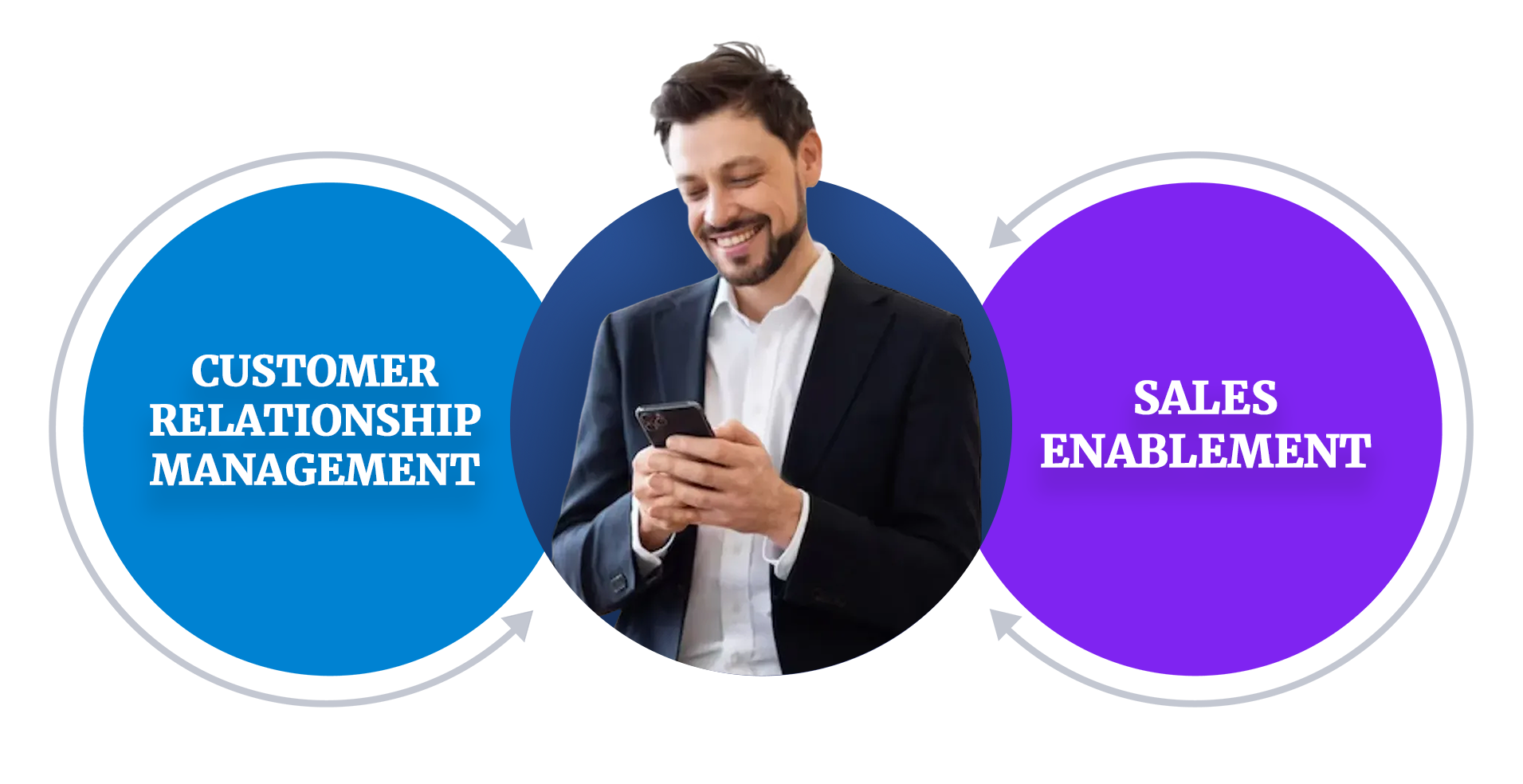
Here's a subtle but critical insight: data quality in the CRM is directly connected to how well the enablement layer prepared the rep.
A rep who understood the buyer's problem (enablement worked) will record better, more contextual CRM notes than a rep who just went through the motions. A rep who knows what discovery questions to ask will capture more complete deal information.
But the opposite is also true: a rep who has trouble logging data (capture friction is high) will be less likely to do the research enablement offers. Why spend 15 minutes prepping content if you're going to hate the logging part anyway? Reps optimize for speed, not quality.
The implication: you can't improve CRM data quality with training and content alone. You have to also reduce the friction of capture. You need both layers working well.
Many organizations spend heavily on enablement platforms and training, then wonder why CRM adoption is weak. They've solved half the problem. Read more about why CRM entry needs a revolution to understand the other half.
To close the gap between enablement and CRM, you need to think about these three layers as a unified system, not separate tools.
Start with these four changes:
The goal: a rep should move from 'I'm prepared' to 'call happened' to 'it's recorded' without ever consciously thinking about the handoff. The infrastructure should be invisible.
For a practical overview of how to approach CRM implementation with capture in mind, explore Hey DAN's capabilities for different sales motions. See Hey DAN's solutions for different sales contexts, or explore CRM data entry best practices.
Organizations that ignore this gap pay a hidden cost:
The organizations that perform best are those that think of enablement, capture, and CRM as a single flow, not three separate systems with hand-offs in between.
Explore how these concepts apply to team challenges. Read about 7 CRM adoption concerns and how closing the enablement-CRM gap addresses most of them.
Learn why the top performers take a different approach. Discover 5 reasons top sales teams use Hey DAN and how capture infrastructure fits into winning sales motions.
For deeper context on the broader challenges, see overcoming sales challenges and how bridging the gap between enablement and CRM removes friction at critical moments.
Sales enablement and CRM are not interchangeable. They're not competitors. They're complementary systems that should work together. But without a capture infrastructure connecting them, they work in isolation.
The winning formula:
When all three work together, the rep's workflow becomes seamless. Prep happens naturally. Selling happens confidently. Recording happens invisibly. Pipeline data is complete, timely, and accurate. That's the goal.


