Comparing AI-driven features, multichannel capabilities, and total cost of ownership for mid-market sales teams
The CRM market has bifurcated. On one side, you have HubSpot and Salesforce, which dominate mindshare but command premium pricing. On the other side, you have Freshsales and Zoho, which serve buyers who ask a simpler question: 'What's the best CRM for the money?'
This segment is growing. Mid-market companies that rejected Salesforce for cost reasons, or HubSpot for feature limitations, are looking at Freshsales and Zoho. Both platforms offer compelling value: modern feature sets, competitive pricing, and reasonable implementation timelines.
But they're not identical. Freshsales is built for sales velocity: AI-driven lead scoring, multichannel engagement, and deal insights designed to help reps sell faster. Zoho is built for organizational flexibility: deep customization, a rich ecosystem of add-ons, and maximum control over CRM configuration. For value-conscious buyers, this distinction determines which platform wins.
Freshsales is a CRM built on the premise that sales is about velocity and conversion. The platform includes AI lead scoring, conversation intelligence, and multichannel engagement (email, phone, SMS) natively. Freshsales assumes that your team wants modern sales tools without the cost of Salesforce or the friction of implementing a complex platform. It's designed for sales teams that want to move fast and leverage AI to get better at selling.
Zoho CRM is a full-featured platform with power and flexibility as its core philosophy. It includes AI scoring, but also extensive customization capabilities, powerful workflow automation, and a large ecosystem of integrated tools. Zoho is built for organizations that want to reshape their CRM to fit their specific business processes, not adapt their processes to fit the CRM.
The strategic question: do you want a pre-optimized platform that's ready to sell (Freshsales), or a flexible platform that you'll customize to your specific needs (Zoho)?
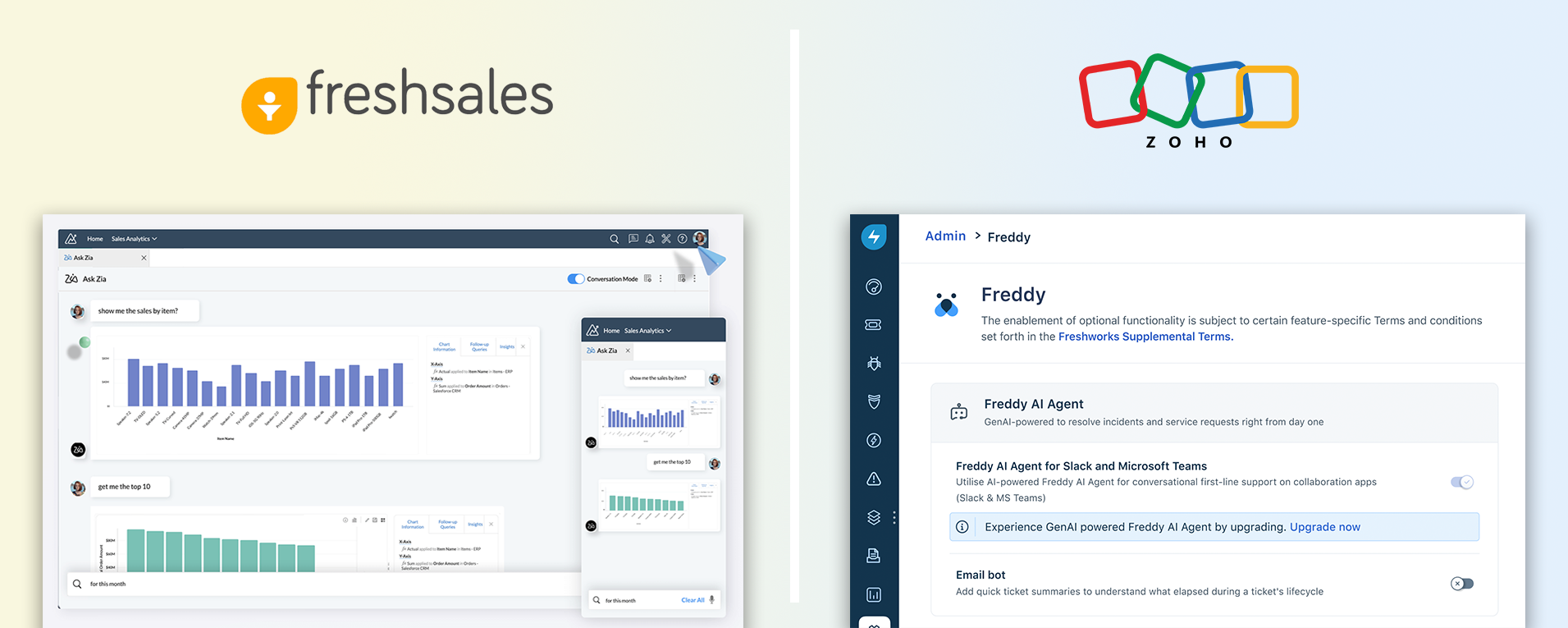
Freshsales' AI strategy is clear: use machine learning to help reps sell better. The platform includes AI-powered lead scoring (which learns from your historical win/loss data), conversation intelligence (which analyzes call recordings and email threads), and deal insights (which flag deals at risk and recommend next steps). These features are built-in and mature.
Zoho's AI approach is more expansive. Beyond basic lead scoring, Zoho offers multiple AI models, predictive analytics, and more granular insights. However, these features often require configuration and interpretation. Zoho gives you more raw analytical power, but requires more expertise to extract value from it.
For sales teams, Freshsales' AI is more immediately useful. It's pre-tuned for sales velocity and provides recommendations that reps can act on. Zoho's AI is more flexible and powerful, but requires your team to understand how to use it effectively. If you want AI that works out of the box, Freshsales wins. If you want AI you can customize to your specific business, Zoho wins.
Modern sales teams don't communicate through email alone. They use phone calls, SMS, video calls, LinkedIn messages, and—increasingly—voice workflows. Freshsales addresses this by building email, phone, and SMS natively into the platform. When a rep sends an SMS to a prospect or records a call, that activity automatically logs into the CRM without manual intervention.
Zoho offers multichannel capabilities, but less natively. You'll integrate Zoho Phonebridge for phone, use a third-party SMS gateway, and combine with other tools to achieve what Freshsales does automatically. This isn't necessarily a weakness—it's flexibility. Some teams prefer assembling their own stack over using Freshsales' opinionated approach.
However, there's a critical insight here: multichannel integration still doesn't solve the data entry problem. Just because Freshsales logs the call automatically doesn't mean the rep is logging the *outcome* of the call. The activity is recorded, but the conversation summary, next steps, and follow-up tasks still require manual input in both platforms.
Freshsales is intentionally less customizable. It has a defined data model, predefined field sets, and bounded workflow options. This constraint is a feature, not a limitation. Because Freshsales doesn't offer infinite customization, you get a system that's fast to configure and consistent across your organization. Customization anxiety doesn't exist because the platform says, 'Here's how we think sales should work—configure within this framework.'
Zoho is the opposite. Almost everything is customizable. Custom fields, custom workflows, custom reporting, custom integrations. This flexibility is powerful for organizations with unique sales processes. But it creates a configuration burden: what should be a simple setup becomes a complex implementation. Teams often bring in consultants just to configure Zoho properly.
For mid-market teams, this difference is significant. If your sales process is standard (which it usually is), Freshsales' constraint is actually a strength—you move fast and don't have to make a thousand configuration decisions. If your sales process is deeply custom (which some organizations have), Zoho's flexibility becomes necessary.
Freshsales adoption tends to follow this pattern: reps love the AI recommendations and multichannel capabilities. The system feels modern and intelligent. But 6-8 weeks in, adoption stalls when reps realize that all the AI in the world can't compensate for the fact that they still have to manually update deal stages, log call outcomes, and create follow-up tasks. The system captured the activity, but not the insight.
Zoho adoption follows a different stall curve. Initial adoption is slower because the system requires more configuration. Once it's customized, adoption may be higher because the system feels tailored to your team's actual process. But eventually, you hit the same wall: no amount of customization solves the fundamental problem that data entry feels like busy work, not selling.
Both platforms are systems of record. Both struggle with adoption because neither captures data from the rep's natural workflow. Freshsales captures more (calls, emails, SMS), but still requires manual interpretation and follow-up logging. Zoho captures what you configure it to capture, but still requires consistent data entry discipline.
A Freshsales rep's workflow looks like this: they make calls (which record automatically), they send emails (which log automatically), they check their AI recommendations (which surface high-priority leads), and then they manually log the conversation summary, next steps, and deal stage update. The multichannel integration saves time, but only on activity logging—not on the interpretation and insight that requires manual work.
A Zoho rep's workflow is more custom, depending on configuration. If your team has built custom workflows, the rep might follow a highly tailored process. But underneath, the same problem exists: something still has to manually extract insight from the call and populate it into the system.
Here's the honest assessment: Freshsales' multichannel capabilities create the illusion of automaticity. Calls are recorded, emails are logged. But this isn't data capture—it's activity logging. True data capture would extract the *substance* of the interaction (decision makers discussed, budget mentioned, timeline discussed) and populate it automatically.
Freshsales Field Challenges:
Zoho Field Challenges:
Freshsales logs more activities automatically (calls, emails, SMS), which creates the impression that data quality will be better. But here's the trap: activity logging ≠ data quality. A call that's recorded but not summarized, an email that's logged but not analyzed for next steps, an SMS that's captured but not followed up on—these are logged activities, not quality data.
Six months after implementation, both Freshsales and Zoho deployments experience identical data decay. Deal stages stall. Contact information becomes outdated. Notes become vague. The difference is that Freshsales' additional activity logging creates a false sense of data completeness—you have lots of logged activities but still lack the insight data that drives selling.
Zoho's more limited activity logging actually creates a more honest assessment of data quality. You're only logging what you explicitly ask for, so data decay is more obvious. This can be an advantage because it forces you to acknowledge the data quality problem and address it directly.
The fundamental issue: neither platform creates the conditions where reps naturally want to maintain data quality. Both require discipline and enforcement. Freshsales adds more automation, but automation of logging isn't the same as automation of insight.
Here's what both Freshsales and Zoho miss: they're both systems of record. Neither is a system of capture. Freshsales gets closer with its multichannel integration, but the difference between 'capturing activity' and 'capturing insight' is critical.
A true voice to CRM workflow layer would work like this: a rep finishes a call, and the system automatically extracts key information—who was on the call, what was discussed, budget involved, timeline, decision makers, next steps. This information is then populated into your Freshsales or Zoho instance as structured data, without requiring the rep to type anything.
This is the missing piece in both platforms. Freshsales logs the fact that a call happened. But it doesn't extract the substance of what was discussed. Zoho can be configured to capture more, but it still relies on rep discipline to do so.
When you add a dedicated CRM data entry capture layer to either platform, adoption accelerates because you've removed the manual entry burden. The rep's workflow becomes: make calls, send emails, execute follow-ups. The capture layer feeds the CRM silently in the background.
The Freshsales vs Zoho decision should not be your only CRM decision. It should be part of a larger question: what's your complete sales infrastructure? That includes:
Most teams get the first item (CRM) right and neglect the others. Then they're surprised when adoption stalls. The right approach is to choose your CRM based on record-keeping needs (speed and simplicity for Freshsales; flexibility and customization for Zoho), and then build a comprehensive capture and intelligence layer on top of it.
Learn how leading sales organizations are implementing this layered approach. Explore CRM solutions that combine platform choice with intelligent capture to solve the adoption problem that pure CRM features can't address.
Choose Freshsales if: You want a modern, AI-first platform with strong multichannel capabilities out of the box, you prefer a lighter implementation timeline, you don't need extensive customization, and you want a system that feels designed for modern sales. Freshsales wins on velocity and ease-of-use.
Choose Zoho if: You need deep customization, you have or will hire resources to configure the platform properly, you want maximum flexibility in how your CRM works, and you're willing to invest in a longer implementation timeline. Zoho wins on power and flexibility.
But here's the decision that matters more: choose the platform where you'll commit to implementing intelligent data capture alongside it. The CRM itself is just the database—what makes it work is the infrastructure that fills it automatically.
Explore how organizations using both platforms are building modern sales workflows with intelligent capture capabilities that eliminate manual entry and accelerate adoption.
Discover why sales teams are outsourcing CRM data entry and alternative capture-based approaches


