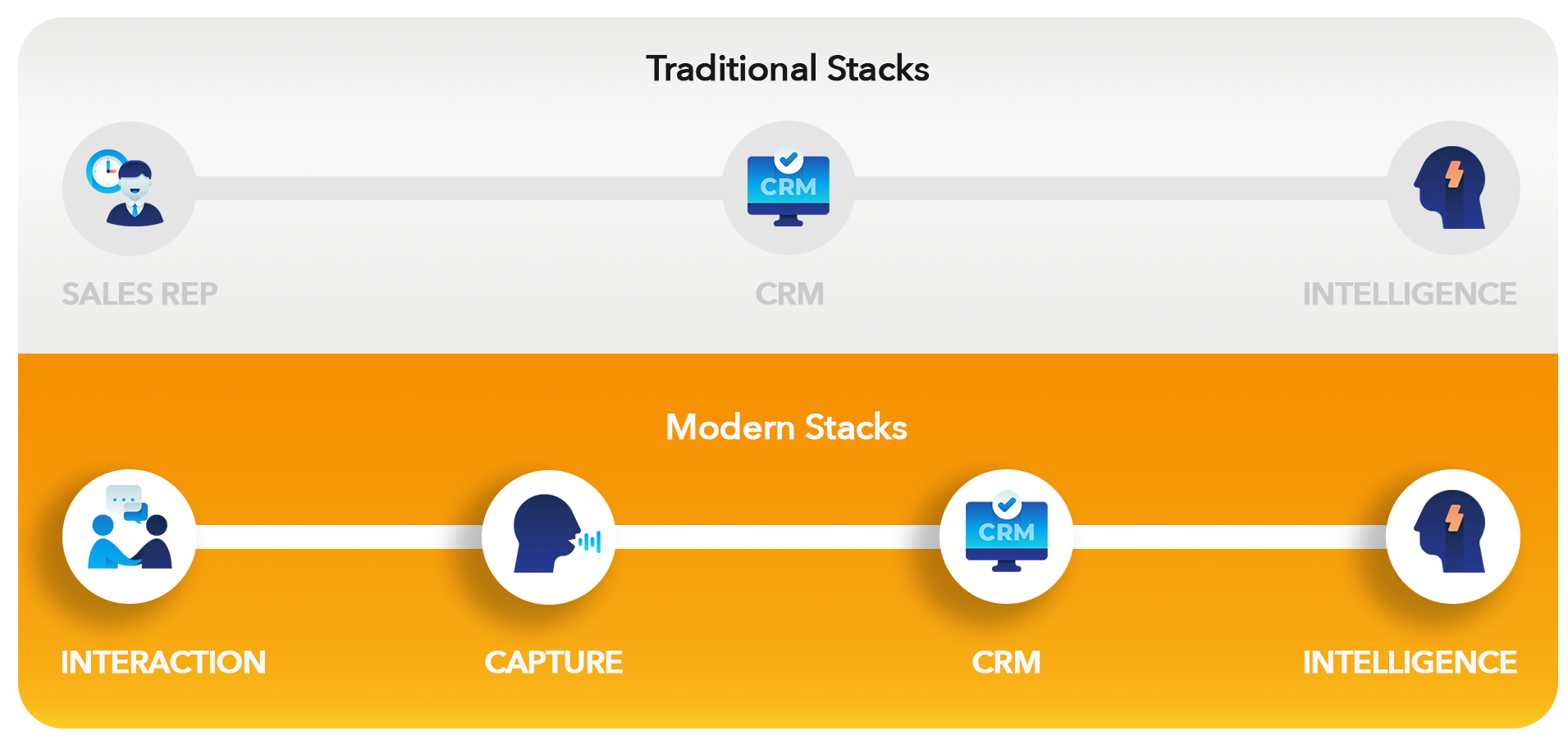
The traditional sales stack (CRM + email + dialer) is broken because it treats CRM as the starting point when it should be the endpoint
Effective modern stacks are built in four interdependent layers: Engagement, Intelligence, Record, and Capture
The Capture layer is where 80% of sales teams are failing — they're trying to retrofit tools onto bad data infrastructure
The layers must be intentionally integrated, not stitched together with APIs and workarounds
Teams that get this right see 3X improvements in cycle time, 40% better forecast accuracy, and significantly higher rep productivity
Why Your Current Stack Doesn't Work
Most sales organizations have invested substantially in technology. They have a CRM, email outreach tools, sales intelligence platforms, activity trackers, forecasting software, and data enrichment services. In theory, this should create a comprehensive, integrated ecosystem. In practice, it's usually a disconnected collection of tools that create silos instead of solving them.
The typical sales tech stack looks like this: reps use an email platform for outreach, a dialer for calls, Slack for communication, a calendar tool for meetings, and then come back to the CRM to log what happened. Data flows in one direction — from the rep into the CRM — and by the time it gets there, it's stale and incomplete. Meanwhile, intelligence tools and forecasting engines are trying to work with bad data, so their insights are unreliable. Leadership loses confidence in the data. Reps stop using the tools. It all becomes an expensive theater.
The reason this happens is architectural. Most sales stacks were built on the assumption that the CRM is the center of the universe — the source of truth where everything originates and terminates. But in reality, the CRM is where data goes to die. By the time information reaches it, it's been filtered, delayed, and decontextualized. And reps know it, so they treat their email inbox or their notes as their real system of record.
What's missing from most stacks is a proper system of capture — the infrastructure that takes raw customer interactions and converts them into clean, structured, immediately-useful information. Without this layer, everything downstream suffers.
Why the Traditional Stack Is Broken
The traditional sales stack evolved because it was the simplest path available when each tool was first built. A CRM existed (Salesforce), so email platforms (Outreach, Salesloft) integrated with it. A dialer existed (Five9, Dialpad), so it sent records back to the CRM. A calendar tool existed, so it synced meetings to CRM. Each tool was optimized in isolation, without thinking about the complete workflow.
This created three fundamental problems:
Data enters the stack at the rep level and must be manually consolidated — The rep is the bottleneck. They use five different tools, and then have to decide what gets logged into the CRM. This creates massive information loss. A thoughtful customer insight discussed in Slack never makes it to the CRM. An email exchange that was actually two weeks of negotiations gets logged as a single activity.
Delays between action and data capture undermine real-time decision-making — A rep talks to a customer at 3pm but doesn't log it until end-of-day or later. By the time that information is in the CRM, leadership is making decisions based on stale data. Forecasts are off because they're based on outdated pipeline status. Real-time coaching is impossible because visibility lags reality.
Downstream tools inherit the sins of upstream capture — Your forecasting tool can't work with incomplete data. Your deal intelligence system can't identify momentum if activity isn't being logged. Your activity tracking can't score engagement if recent interactions are missing. Every tool you add downstream just adds more complexity without solving the root problem.
The Four Layers of Sales Execution
A modern sales stack should be built in four interdependent layers, each with a specific purpose, and each feeding information into the next.
Think of it like a manufacturing process. Layer 1 (Engagement) is the raw material — the customer interactions and conversations happening every day. Layer 2 (Intelligence) is the refining step — taking raw customer interactions and extracting insights. Layer 3 (Record) is the finished product — the structured, documented information that represents your system of record. Layer 4 (Capture) is the often-overlooked infrastructure that connects all three — the machinery that turns raw interactions into refined insights into documented records. Without Layer 4, you're trying to do manufacturing by hand.
Layer 1: Engagement — Where Customer Interactions Happen
The Engagement layer is where reps actually interact with customers. It includes:
Meeting infrastructure (calendar, video conferencing, meeting scheduling)
This layer is already well-developed at most organizations. The tools are mature, the integrations are solid, and reps know how to use them. The problem isn't Layer 1. It's how Layer 1 information gets captured and moved downstream.
Most stacks assume Layer 1 tools will push their own data to downstream layers. An email platform logs email sends and opens directly to the CRM. A calendar tool syncs meetings. But this approach creates fragmented, incomplete data. The most important information from that customer interaction — the substantive conversation, the buying signals, the customer concerns — doesn't fit into a standard API field, so it gets lost or manually typed later.
Layer 2: Intelligence — Extracting Insights from Engagement
The Intelligence layer takes raw customer engagement and extracts meaningful signals. It answers questions like: Is this deal progressing? What are the key decision factors? Who are the real stakeholders? What's our probability of being close?
Tools in this layer include:
Call recording and transcription (Chorus, Gong, Fireflies)
These tools are powerful when they're fed clean data. A call recording tool can identify buying signals if the conversation is actually recorded and transcribed. An engagement scoring system can predict close probability if engagement data is complete and real-time. But if your upstream capture is weak, these tools are only as good as their input.
Layer 3: Record — Your System of Record
The Record layer is your CRM. It's where structured, verified, documented information lives. This includes:
Core CRM functionality (Salesforce, HubSpot, Pipedrive, MS Dynamics)
Account hierarchy and contact records
Deal documentation and history
Activity logs and communication history
Sales processes and stage definitions
Reporting and compliance records
The CRM is critical, but it's often treated as the starting point instead of the ending point. Reps are expected to initiate information in the CRM — to add accounts, create contacts, define deals. But that's backwards. The CRM should be where information flows to, not from. The rep's job shouldn't be to populate the CRM; it should be to have customer conversations. The system should handle getting that information into the CRM.
Layer 4: Capture — The Missing Infrastructure Layer
Layer 4 is where most modern sales stacks fail. The Capture layer is the infrastructure that takes customer interactions from Layer 1, extracts intelligence in Layer 2, and moves structured information into the Record layer (Layer 3). It's the connective tissue that makes the whole stack work.Traditional stacks assume capture happens manually — the rep remembers to log activity, types notes, fills in fields. Modern stacks automate capture. Tools in this layer include:
CRM data entry systems that allow reps to speak notes immediately after meetings
Conversation intelligence that automatically extracts key information from calls and syncs to the CRM
Email integration that captures the full conversation thread and automatically updates deal status
Calendar sync that automatically logs meetings and extracts action items
Meeting transcription that converts conversations to structured CRM entries
Data enrichment pipelines that automatically populate missing company and contact information
Field completion workflows that ensure critical information is captured before deals advance
The Capture layer is what separates modern, high-performing sales stacks from traditional ones. It's the difference between a rep manually creating 5-10 CRM records per day (which takes hours and is error-prone) versus automatically capturing and structuring 50+ customer interactions per day with 99% accuracy. It's the difference between trying to build a forecast 3 days late (when activity was actually happening) versus having real-time insights into deal momentum. It's the difference between a CRM that's used for compliance versus a CRM that's actually trusted for decision-making.
How the Layers Connect: The Data Flow Architecture
Here's how a modern stack should work:
Engagement happens in Layer 1 — Reps talk to customers via email, calls, meetings, Slack. These interactions are the raw material.
Capture automatically extracts information in Layer 4 — Instead of waiting for the rep to log activity, capture systems are automatically listening, recording, and extracting. A call ends and the system immediately transcribes it, identifies key stakeholders and concerns, and extracts next steps. An email thread completes and the system recognizes it as a proposal discussion and flags it in the deal record. A meeting happens and the system automatically logs it with action items.
Information flows into the Record layer in Layer 3 — Clean, structured information is automatically populated into the CRM. Not as a manual task, but as an automated process. The rep doesn't have to remember to update the deal status; the system recognizes the customer said 'yes' and updates it. The rep doesn't have to manually log activities; they're automatically captured and associated with the right records.
Intelligence systems in Layer 2 now have good data to work with — With complete, accurate, real-time CRM data, your forecasting engine can make accurate predictions. Your deal intelligence can identify truly stalled opportunities. Your engagement scorer can predict close probability with confidence. These tools now actually work.
Leadership in Layer 2 can make real-time decisions — With real-time intelligence and data, managers can coach reps effectively, leadership can forecast accurately, and the entire organization has visibility into the business.
The key difference: in traditional stacks, information flows from rep → CRM → intelligence. In modern stacks, information flows from customer interaction → capture → CRM → intelligence. The rep is removed from the data entry equation, and the system of capture handles the infrastructure.
Building Your Stack: A Decision Framework
If you're building or rebuilding your sales execution stack, here's how to approach it:
Start with your endpoints, not your starting points — Begin by defining what information you need in your CRM to make good decisions (revenue, forecast, capacity). Then work backward to figure out what data you need to capture to populate those fields accurately.
Map your customer interaction journeys — How do customers engage with you? Phone calls? Email? Meetings? LinkedIn messages? Each interaction type needs a capture solution. A complete stack doesn't miss channels.
Prioritize Layers 3 and 4 before Layer 1 — Most teams over-invest in engagement tools (email platforms, dialers, CRMs) before they've solved capture. Start with: what CRM am I using (Layer 3)? What capture infrastructure will feed it (Layer 4)? Then add engagement tools (Layer 1) that work with your capture layer.
Design for integration before buying tools — Before you select specific vendors, map the data flow between layers. How will your email tool feed your CRM? How will your dialer log calls? How will your intelligence platform get its data? Design the architecture first, then select tools that fit it.
Solve capture problems with process + technology, not just tools — Even the best capture technology won't work if your team culture doesn't support it. You need both: tools that make capturing data easy, and processes that make it standard practice.
Plan for evolution, not replacement — Your stack will change over time. Ensure each layer has clear integration points so you can upgrade tools without rebuilding the entire architecture.
Real-World Stack Failure: Why Most Integrations Don't Work
Consider a real scenario that's playing out at thousands of companies: A VP of Sales implements a new deal intelligence tool that's supposed to improve forecast accuracy. The vendor promises seamless integration with Salesforce. The implementation takes 2 weeks, APIs are configured, and the tool is live. The VP is excited.
Three months later, the intelligence tool is generating deal scores and recommendations, but nobody trusts them. Deals that the tool predicted would close are still in the pipeline, months later. Deals that looked at risk actually closed. The VP concludes the tool is useless.
The real problem: the tool is working correctly; the data feeding it is broken. Reps are logging activity sporadically, deal status updates happen days after customer conversations, and customer context (pain points, decision criteria, stakeholder info) is missing from the CRM. The intelligence tool is making accurate predictions based on incomplete data.
The integration 'worked' in the technical sense — the API was configured correctly and data was flowing. But it failed in the architectural sense — the capture layer wasn't in place to ensure good data was flowing.
This is why so many integrations disappoint: teams are trying to integrate the wrong layers. They're connecting tools without solving the foundational capture problem.
The Capture Layer as Foundation: Why It Comes First
A modern sales execution stack is only as good as its capture layer. This is the most important insight in this article: get capture right, and everything else becomes easier. Get it wrong, and no amount of fancy tools will fix it.Here's why capture deserves to be your priority:
Capture unlocks everything else — Every tool in Layer 2 (intelligence) and every decision in your CRM depends on capture. Your forecasting accuracy depends on it. Your pipeline visibility depends on it. Your rep productivity depends on it.
Capture is the hardest layer to fix after-the-fact — You can upgrade your CRM. You can add new intelligence tools. But if your capture is fundamentally broken, these upgrades won't help. Fixing capture requires changing rep behavior and potentially adopting new tools, which is hard.
Capture is where efficiency lives — Reps spend 1-2 hours per day on manual CRM data entry. Fixing capture can recover most of that time. No other investment in your stack will have that ROI.
Capture is the leverage point for adoption — Reps resist tools that create more work. If your CRM data entry is manual and cumbersome, reps will use workarounds. If it's automated and frictionless, they'll trust the system.
The Modern Stack in Practice: What It Looks Like
Here's what a modern, well-architected sales execution stack looks like in practice:
Single source of truth for pipeline and customer info
Layer 4: Capture
Infrastructure to populate the record
Voice-based CRM entry, call transcription, email sync, data enrichment
Clean, real-time, complete data flowing into the CRM
Notice that these layers are interdependent. Engagement tools alone don't move deals; they need intelligence to identify which customer interactions matter. Intelligence tools don't inform decision-making without a Record to structure the insights. And all three layers fail without a Capture layer that ensures data flows cleanly and in real-time.
This is why it's not about which individual tools you choose (Salesforce vs. HubSpot vs. Pipedrive; Outreach vs. Salesloft). It's about ensuring your four layers are properly integrated. A team using Salesforce, Gong, Outreach, and a voice-based capture solution will outperform a team using the most expensive tools if the cheaper tools are better integrated.
Building Your Stack: Practical Implementation Path
If you're ready to build or rebuild your stack, here's a practical progression:
Month 1: Audit and design. Map your current stack against the four layers. Identify gaps in each layer. Design the ideal data flow. This is working-backward-from-outcomes work, not tool shopping.
Month 2-3: Fix the foundation. Implement or upgrade your CRM (Layer 3) and your capture infrastructure (Layer 4). This is the critical foundation. Don't rush this.
Month 3-4: Upgrade intelligence. Now that you have good data flowing, add or upgrade intelligence tools (Layer 2). These tools will actually work now that they have quality input.
Month 5+: Optimize engagement. Finally, make sure your Layer 1 (Engagement) tools are fully integrated with the stack. Add new outreach and communication tools as needed, confident that they'll feed the rest of the system.
This progression is deliberately different from the "buy CRM first, then sales tools" approach that most organizations follow. It prioritizes foundation before adding complexity.
Making the Stack Real: Integration Principles
A framework is only useful if it's actionable. Here are the integration principles that make a four-layer stack actually work:
Principle 1: Real-time data flow, not batch processes — Data should flow from engagement to capture to record as it happens, not in batch syncs. A customer conversation at 3pm should be in your CRM by 3:15pm, not tomorrow.
Principle 2: Single source of truth — Your CRM is the record. Every piece of information that flows into it should be flowing FROM capture, not DUPLICATED from multiple engagement sources.
Principle 3: Data enrichment upstream, not downstream — If a piece of information is missing, the capture layer should enrich it before it reaches the CRM. Don't let dirty data flow into the record.
Principle 4: Every integration point should be bidirectional — Your email tool shouldn't just push data to the CRM; it should pull context from it (account info, deal status) to inform messaging. Your intelligence tools shouldn't just report on CRM data; they should push insights and recommendations back into the CRM.
Principle 5: Flexibility without fragmentation — Different parts of your organization might need different tools. A sales development team might use different engagement tools than an account executive team. But all their data should flow through the same capture and record layers.
The Competitive Advantage: Why This Matters
Companies that get their sales execution stack right see measurable competitive advantages:
3X faster data entry — Reps speak notes instead of typing them, reducing admin time from 1-2 hours per day to 10-15 minutes
40% better forecast accuracy — With clean, real-time data, forecasting tools and human judgment both improve dramatically
20-30% shorter sales cycles — Real-time visibility into deal momentum means reps can identify and address bottlenecks faster
25% improvement in win rates — Sales intelligence and engagement tracking mean reps are coached on the approaches that actually work
Higher rep retention — Reps spend more time selling and less time on admin. They trust the system. They want to stay.
These aren't incremental improvements. They're transformative. And they all flow from getting the stack architecture right.
Avoiding Common Stack Implementation Mistakes
Mistake 1: Treating the stack as a menu of tools instead of an architecture — Teams shop for individual tools without thinking about how they fit together. "We need better intelligence" so they buy Gong. "We need better forecasting" so they buy another tool. Each one works fine individually, but they don't talk to each other. Start with architecture, then select tools.
Mistake 2: Keeping manual capture as the default — Teams spend $100K on new intelligence tools while reps are still manually typing notes into the CRM. The ROI of the expensive tool is capped by the bad capture layer. Fix capture first.
Mistake 3: Over-integrating at the start — Every tool you add creates integration complexity. Start with the minimum viable stack (CRM, capture, one intelligence tool) and expand from there. Add tools only when you've proven value from the previous layer.
Mistake 4: Neglecting adoption and change management — The best stack architecture won't work if reps don't use it. Invest in training, incentives, and reinforcement. Make the new workflow obviously better than the old one.
Mistake 5: Choosing tools based on demos instead of architecture fit — A tool might look great in a demo but integrate poorly with your stack. Choose tools that fit your architecture, not just tools that look good.
Your Stack Reflects Your Strategy
Your sales execution stack is a direct reflection of how you believe sales work should happen. Traditional stacks assume reps are the data entry people — they talk to customers, then come back and manually log everything. Modern stacks assume reps are sales people — they talk to customers, and the system handles logging.
This is a fundamental mindset shift. And it changes everything: how much time reps spend on admin, how accurate your forecasts are, how effective your intelligence is, how well your team scales.
If you're building your stack for 2025 and beyond, start with the principles in this article. Begin with Layer 3 (your Record/CRM) and Layer 4 (your Capture infrastructure). Ensure they're solid and integrated. Then layer on Layer 2 (Intelligence) and Layer 1 (Engagement), confident that they're built on a foundation that will actually support them. For a deeper dive on specific tools and approaches, read the other articles in this series on sales workflow automation and pipeline accuracy improvements.
To explore how modern capture infrastructure fits into your sales stack, check out Hey DAN's capabilities and learn how teams are using voice-based capture to modernize their data entry infrastructure. And explore how these concepts apply to your specific sales operations through our solutions page.
Your stack is foundational to everything else in sales operations. Get it right, and everything else becomes easier. Get it wrong, and you'll be perpetually frustrated by tools that don't work together and data that doesn't flow. The framework in this article gives you the mental model to design a stack that actually works.